The electric grid is undergoing its most significant transformation in decades. Distributed energy resources, including solar, battery storage, EV charging infrastructure, and behind-the-meter assets, are changing how utilities plan, operate, and maintain the grid.
As DER adoption grows, utilities must manage more complex, bidirectional networks while maintaining grid reliability, service quality, and regulatory compliance. Traditional asset management and field service processes often struggle to keep pace with the volume of new assets, real-time data, and maintenance demands created by this shift.
That is why many utilities are turning to IFS Cloud. Its enterprise asset management, field service, and predictive maintenance capabilities help utilities improve visibility across distributed assets, optimize field operations, and respond faster to changing grid conditions without compromising reliability or customer satisfaction.
TL;DR: How IFS Supports Modern DER Operations
-
Rising DER penetration and electrification create visibility gaps that legacy ERP systems struggle to close.
-
IFS Cloud unifies enterprise asset management, field service, and analytics for end-to-end grid operations.
-
Battery storage, EV charging, and behind-the-meter DERs require proactive maintenance across distributed networks.
-
IoT integration and data analytics in IFS help monitor DER performance and reduce unplanned downtime.
-
Predictive maintenance and workflow automation improve system reliability and support resource adequacy planning.
-
IFS Cloud's composable architecture lets utilities modernize incrementally without disruptive rip-and-replace projects.
-
Real-time visibility into grid assets and field operations supports faster outage response and regulatory reporting.
How DERs Are Rewriting the Utility Operating Model
Distributed energy resources are fundamentally changing how utilities plan, operate, and maintain the grid. Solar installations, battery storage systems, EV charging infrastructure, and customer-sited generation are shifting the industry from centralized, predictable power flows to a more complex, dynamic network where energy moves in multiple directions and demand patterns shift rapidly. This transformation demands new approaches to asset management, field operations, and data analytics that many legacy systems simply weren't designed to handle.
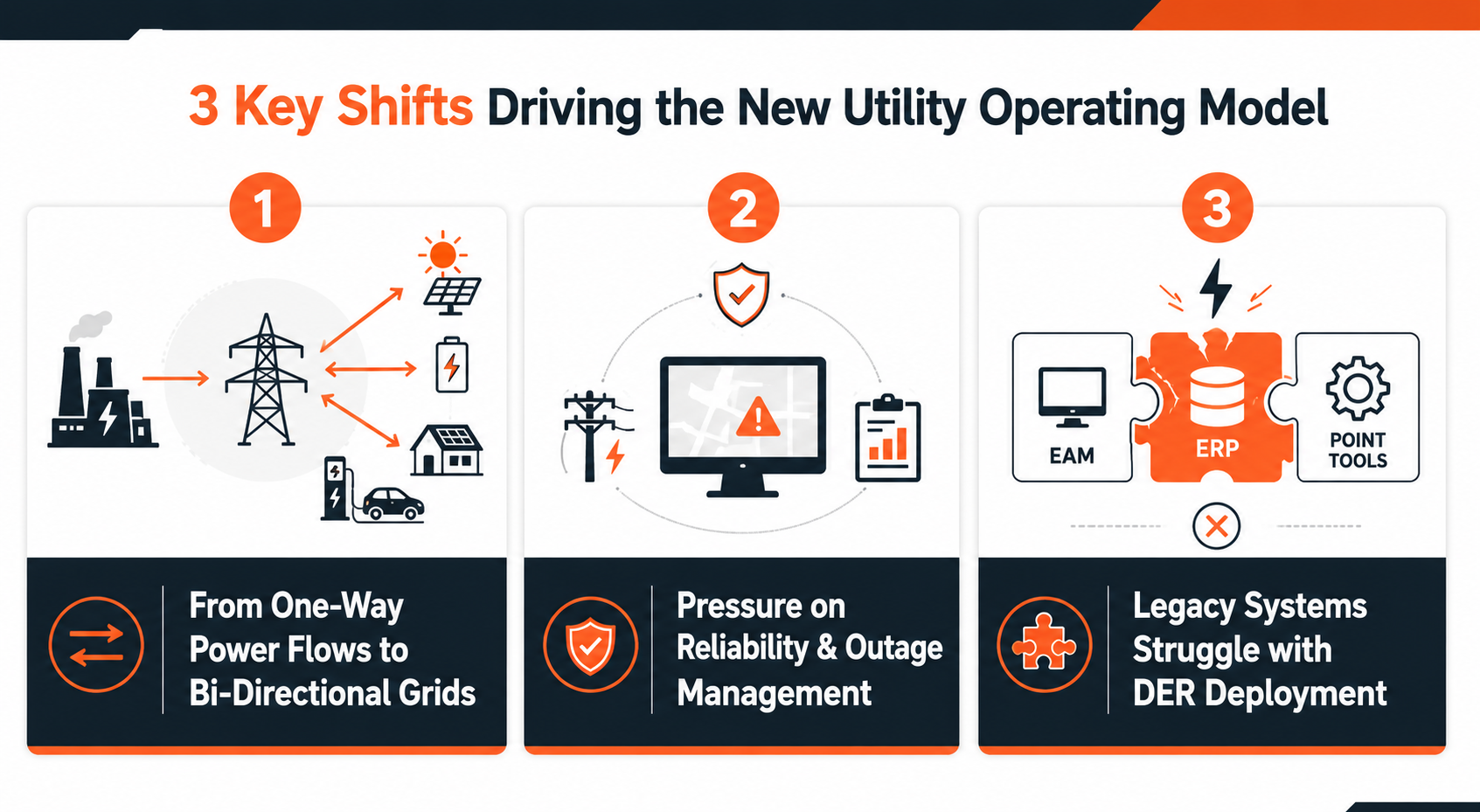
From One-Way Power Flows to Bi-Directional, Data-Heavy Grids
Traditional utility operations were built around centralized generation, moving power through transmission and distribution networks to end users. DER deployment changes that model by adding customer-sited generation, battery storage, EV charging, and other distributed assets that can consume, store, or export energy.
That shift creates new challenges around resource adequacy, voltage regulation, load forecasting, grid reliability, and system reliability. Utilities need real-time visibility into how distributed assets are performing, where downtime risks may emerge, and how DERs affect grid stability.
The data challenge also grows quickly. IoT-enabled grid assets and storage systems generate large volumes of operational data that must connect with maintenance schedules, asset lifecycle records, predictive maintenance, and field service workflows. Without scalable enterprise software, utilities struggle to turn that data into proactive decisions.
Pressure on Grid Reliability, Outage Management, and Regulatory Reporting
As distributed energy resources become more common, utilities face higher expectations for reliability, outage response, and regulatory reporting. Renewable energy growth, electrification, and customer satisfaction goals all depend on resilient grid operations.
-
Regulatory scrutiny intensifies: Utilities need stronger reporting on renewable integration, DER performance, regulatory compliance, and grid reliability metrics.
-
Outage scenarios grow more complex: Behind-the-meter DERs can affect restoration workflows, especially when utility-owned, customer-owned, and third-party energy systems interact.
-
Resource adequacy planning shifts: Utilities must account for variable renewable generation, EV charging demand, battery storage, and storage systems when planning capacity.
-
Customer satisfaction depends on uptime: As customers rely more heavily on electricity for transportation, heating, and daily operations, even brief downtime can affect service delivery and trust.
These pressures make connected workflows more important. Utilities need digital technologies that link outage data, crews, inventory, grid assets, compliance records, and field operations so they can respond faster and maintain reliable service.
Read Next: ERP for Energy Industry: Streamlining Utility & Manufacturing Operations
Why Legacy EAM, ERP, and Point Tools Struggle with DER Deployment
designed for a centralized grid model. These systems often struggle to track distributed assets across locations, integrate IoT data from battery storage or EV charging infrastructure, or coordinate field operations for DER installation and maintenance.
Siloed data limits end-to-end visibility. Procurement may not align with maintenance needs, workforce planning may not reflect specialized DER skills, and manual workflows can slow response when issues arise. As DER penetration grows, these gaps create operational drag and make grid modernization harder to scale.
Utilities need a more integrated, composable, and scalable approach. IFS Cloud can support that shift by connecting enterprise asset management, service management, procurement, analytics, and lifecycle data in one operational environment. For the utilities sector and broader energy sector, that foundation helps transform DER deployment into a more proactive, resilient, and optimized operating model.
How IFS Helps Utilities Manage Distributed Energy Resources End-to-End
Utilities are increasingly adopting IFS Cloud because it gives them a connected platform for managing grid assets, DER deployment, field operations, and asset lifecycle performance. Instead of stitching together disconnected systems, utilities can use IFS for enterprise asset management, field service management, analytics, and workflows that support energy distribution, renewable integration, and electrification initiatives.
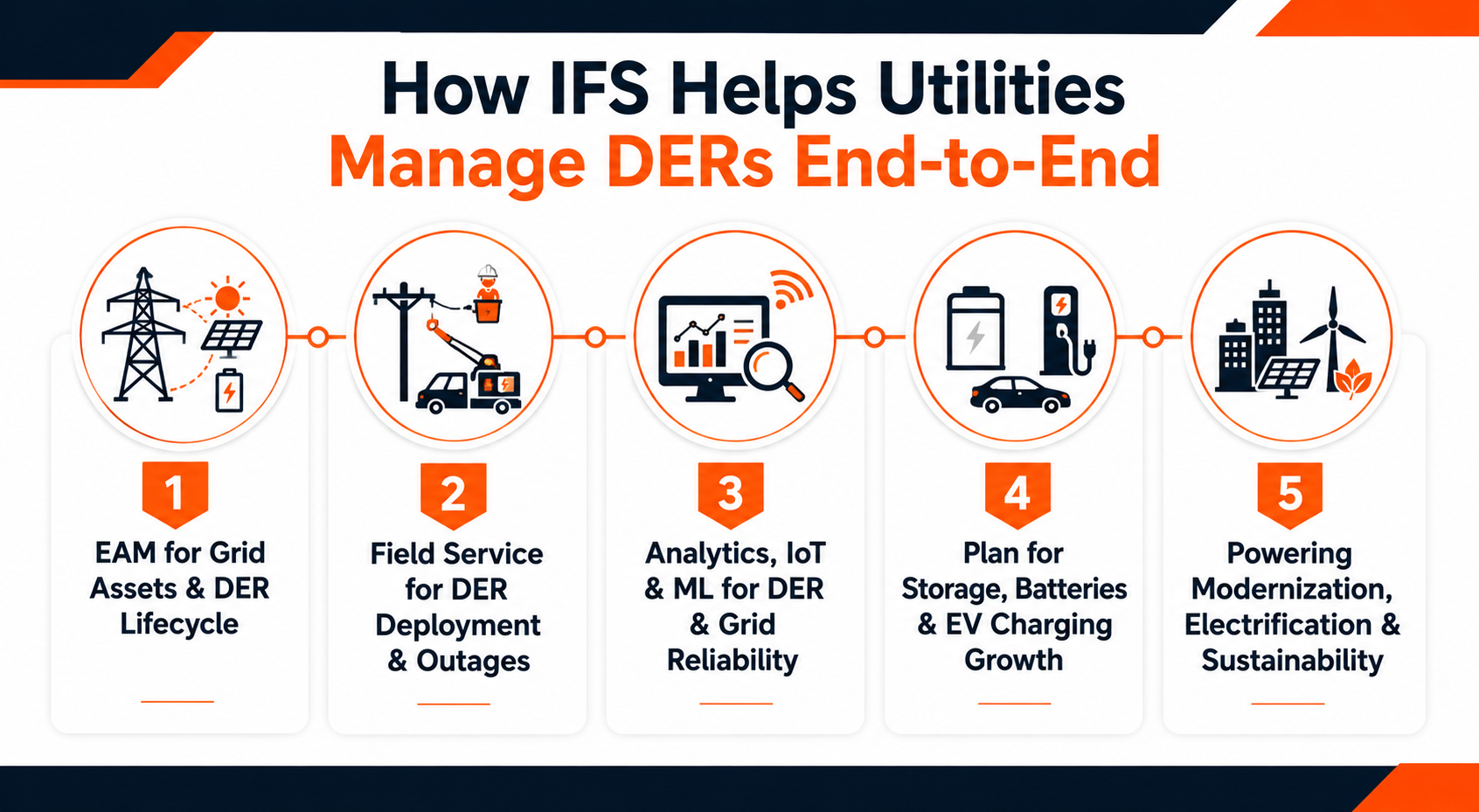
Using IFS EAM to Manage Grid Assets, DER Interconnections, and Lifecycle Performance
Enterprise asset management in IFS Cloud gives utilities a structured way to track grid assets, DER interconnection points, and the equipment that supports distributed generation and storage. Assets such as transformers, inverters, battery storage systems, and EV charging stations can be managed with lifecycle data, including installation date, maintenance history, warranty information, and performance metrics.
That visibility matters as utilities manage thousands of distributed assets across a service territory. With accurate asset data, teams can support predictive maintenance, reduce unplanned downtime, and improve grid reliability instead of relying only on time-based schedules.
When a DER interconnection requires inspection or maintenance, IFS EAM can help trigger work orders, allocate resources, and track completion. For transmission and distribution assets that interact with behind-the-meter DERs, lifecycle visibility also helps utilities understand equipment stress, plan upgrades, and avoid reliability gaps as DER deployment scales.
Read Next: The Maintenance Team's Guide to EAM: From Basics to Best Practices
Field Service Management for DER Deployment, Outage Response, and Behind-the-Meter Work
Coordinating field operations across a distributed network requires more than spreadsheets and phone calls. IFS field service management capabilities help utilities manage DER-related work with better scheduling, dispatch, documentation, and resource planning.
-
DER installation and commissioning: Field service workflows in IFS can support the scheduling, dispatch, and documentation needed to install solar arrays, battery storage, and EV charging infrastructure, helping crews arrive with the right equipment, permits, and technical specifications.
-
Proactive maintenance and inspection: Service management tools help utilities schedule inspections for DER interconnections and behind-the-meter systems, reducing the risk of equipment failures that could affect grid stability or customer satisfaction.
-
Outage response and restoration: During an outage, IFS can help coordinate crew dispatch, track restoration progress, and support customer communication, with visibility into affected DER assets and related field work.
-
Resource allocation and workforce planning: IFS supports planning around technician skills, certifications, availability, and location, helping utilities assign the right crews to specialized DER work and improve service delivery.
Analytics, IoT, and Machine Learning for Proactive DER and Grid Reliability
IFS Cloud can support IoT integration and data analytics so utilities can move from reactive maintenance toward more proactive, data-driven operations. Telemetry from DER assets, battery storage systems, and grid sensors can be connected with asset lifecycle data and maintenance records to help identify patterns that may signal equipment issues.
Machine learning can support predictive maintenance by helping teams anticipate failures, prioritize inspections, and schedule work before small issues escalate into outages. This is especially valuable for distributed energy resources, where equipment is spread across many locations, and manual monitoring is difficult to scale.
Analytics can also improve DER deployment decisions. Utilities can assess how existing DERs are performing, where new installations may be appropriate, and which grid modernization investments are likely to support reliability, operational efficiency, and sustainability goals.
Read Next: The Benefits of AI in ERP Systems: A Deep Dive into IFS Applications
Planning for Storage Systems, Battery Storage, and EV Charging Growth
As battery storage and EV charging infrastructure become more important to energy systems, utilities need enterprise software that can manage these assets as part of broader grid operations. IFS Cloud can help utilities track storage systems, charging assets, maintenance needs, resource allocation, and lifecycle performance in one operational environment.
-
Battery storage as grid assets: IFS Cloud can help utilities manage battery storage systems with the same rigor as traditional grid equipment, including performance tracking, maintenance scheduling, and lifecycle management.
-
EV charging infrastructure integration: As utilities deploy or support EV charging networks, IFS can help manage installation, maintenance, performance visibility, and field service workflows for charging stations.
-
Phased DER deployment planning: Resource planning and procurement workflows in IFS can help utilities stage DER rollouts, align equipment delivery with installation schedules, and reduce the risk of stranded assets or overloaded grid segments.
-
Coordination with energy management systems: IFS does not replace specialized energy management, DERMS, or SCADA systems. It provides the asset, service management, workflow, and lifecycle foundation that helps ensure DER-related equipment is maintained, inspected, and available when grid operators need it.
Supporting Grid Modernization, Electrification, and Sustainability with a Composable Enterprise Platform
One reason utilities choose IFS Cloud is its composable architecture, which allows teams to modernize incrementally instead of attempting a disruptive, all-at-once transformation. A utility may begin with enterprise asset management for grid assets and DER interconnections, then add field service management, analytics, IoT integration, and automation as its digital transformation roadmap matures.
That adaptability matters in the utilities sector, where operational continuity, regulatory reporting, renewable energy targets, and electrification pressures are constantly shifting. As DER deployment grows, IFS Cloud can support new asset types, workflows, data sources, and service models without requiring utilities to rebuild the entire platform.
By connecting asset data, field operations, procurement, service management, and analytics, IFS helps utilities improve visibility across energy distribution and grid modernization programs. That foundation supports operational efficiency, reduced downtime, better customer satisfaction, and more resilient service delivery as utilities scale renewable energy, battery storage, EV charging, and other distributed energy resources.
Are You Ready to Use IFS for DER Management?
Not every utility is at the same stage of DER maturity or digital transformation readiness. Understanding where your organization stands can help you build a realistic roadmap for using IFS Cloud to support distributed energy resources, grid reliability, and operational efficiency.
The goal is not to replace every existing system at once. It is to identify where IFS, IFS ERP, EAM, field service management, analytics, and workflow automation can improve visibility, service delivery, and resource planning across DER deployment.
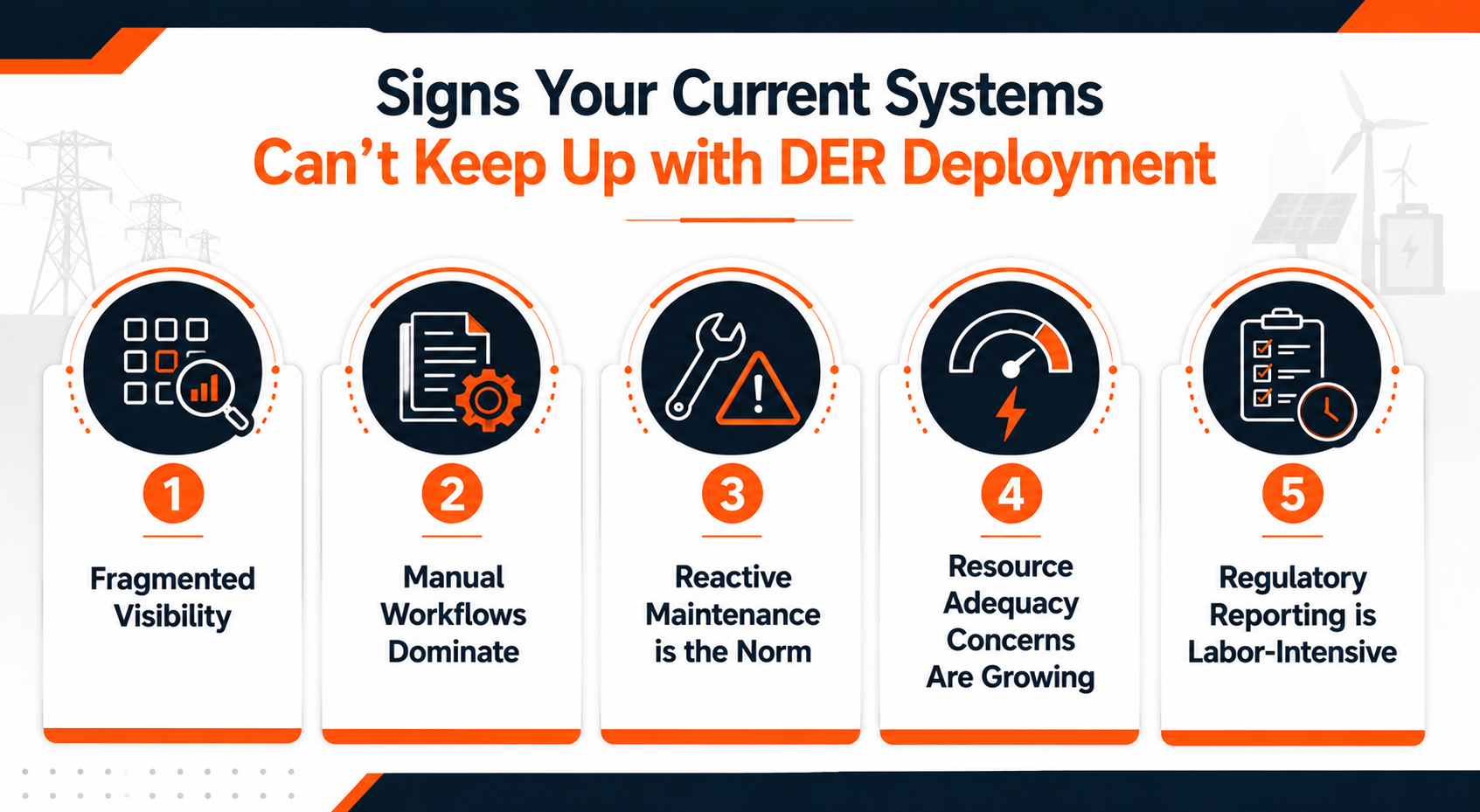
Signs Your Current Systems Can't Keep Up with DER Deployment
If these challenges are showing up across your grid operations, it may be time to evaluate whether your enterprise resource planning, enterprise asset management, and service management tools are fit for a DER-heavy grid.
-
Fragmented visibility: You rely on disconnected systems to track grid assets, DER interconnections, field operations, and outage activity, making it difficult to get a unified view of performance or identify emerging reliability issues.
-
Manual workflows dominate: Scheduling maintenance, coordinating outage response, planning DER installations, or managing procurement still depend on spreadsheets, emails, and phone calls instead of automated workflows and real-time data.
-
Reactive maintenance is the norm: Teams respond to equipment failures after they happen rather than using predictive maintenance, IoT data, and analytics to reduce downtime before it affects customers.
-
Resource adequacy concerns are growing: You struggle to forecast how distributed generation, battery storage, storage systems, and EV charging demand affect grid capacity, supply and demand, and system reliability.
-
Regulatory reporting is labor-intensive: Compiling data for renewable integration, grid reliability, DER performance, and regulatory reporting requires significant manual effort and increases the risk of errors or delays.
Read Next: IFS Integration Project Best Practices: What to Know Before You Start
Key Capabilities to Prioritize in an IFS-Based DER Roadmap
When planning an IFS Cloud deployment for distributed energy resources, focus on capabilities that support grid reliability, operational efficiency, and scalable DER deployment. Start with EAM for grid assets and DER interconnections, so teams have accurate lifecycle data, maintenance schedules, and asset history for the equipment that matters most.
Then add field service management to improve coordination for DER installation, inspection, behind-the-meter DERs, and outage response. This helps utilities improve workforce planning, resource allocation, and service delivery as field operations become more complex.
Build a data analytics foundation that can connect IoT data from battery storage, EV charging, renewable energy assets, and other energy systems. Real-time visibility helps utilities make more proactive decisions and optimize maintenance, planning, and grid modernization investments.
IFS should also complement existing SCADA, outage management, DERMS, and energy management systems rather than replace them. A composable, adaptable roadmap allows the utility to modernize in phases, add advanced technologies like AI and machine learning, and support scaling across the utilities sector, energy sector, and adjacent oil and gas operations where relevant.
Practical First Steps for COOs and Grid Ops Directors
Getting started with IFS for DER management does not require a massive upfront commitment. Begin with a current-state assessment, then build an agile roadmap that connects quick wins to longer-term digital transformation goals.
-
Map your DER and grid asset footprint: Document where distributed energy resources are deployed, which transmission and distribution assets they interact with, and where current systems have visibility gaps or workflow bottlenecks.
-
Identify quick-win opportunities: Look for areas where IFS Cloud can improve predictive maintenance, field service coordination, resource allocation, or real-time visibility without requiring extensive customization.
-
Engage cross-functional teams: Bring together IT, operations, field service, procurement, and asset management leaders to assess data readiness, IoT integration needs, and how digital technologies can support grid modernization and sustainability goals.
-
Evaluate integration requirements: Define how IFS will connect with SCADA, outage management, DERMS, energy management, and other enterprise software so that critical data flows support operational continuity.
-
Build a phased roadmap: Start with core enterprise asset management and field service management, then expand into analytics, IoT, machine learning, and advanced workflow automation as DER deployment grows.
With the right roadmap, IFS Cloud can help utilities transform DER management from a reactive, fragmented process into a more proactive, resilient, and scalable operating model. IFS offers the strongest value when it connects asset lifecycle data, field operations, service management, procurement, analytics, and resource planning into an end-to-end foundation for modern energy distribution.
Turning DER Complexity Into Operational Advantage
Distributed energy resources are transforming utility operations, creating new challenges around grid reliability, asset management, and field service coordination. IFS Cloud offers a unified platform that helps utilities manage DER deployment, optimize maintenance workflows, and gain the real-time visibility needed to operate a more complex, bidirectional grid.
-
Unified visibility: IFS Cloud integrates grid assets, DER interconnections, and field operations into a single platform, eliminating data silos and improving decision-making.
-
Proactive maintenance: Enterprise asset management and predictive analytics reduce unplanned downtime and strengthen grid reliability as distributed assets proliferate.
-
Scalable modernization: IFS's composable architecture supports incremental digital transformation, letting utilities add capabilities as DER deployment and electrification demands evolve.
From strategy to deployment, the right partner turns IFS into real grid resilience.
With deep experience in enterprise asset management, field service management, and utilities sector modernization, Astra Canyon helps energy companies in configuring IFS to handle the complexity of distributed energy resources, improve grid reliability, and reduce downtime as electrification and renewable integration accelerate.
Schedule a consultation to explore how IFS Cloud can modernize DER operations and strengthen grid reliability across your service territory.
FAQs
How Can IFS Cloud Help Utilities Manage Distributed Energy Resources More Effectively?
IFS Cloud provides a unified platform that integrates enterprise asset management, field service management, and analytics for DER operations. The platform supports predictive maintenance by combining IoT telemetry with asset lifecycle data, helping utilities identify potential equipment failures before they cause outages. Real-time visibility into grid assets and DER performance enables faster decisions about resource allocation, outage response, and capacity planning across distributed networks.
What Is the Difference Between Traditional EAM Tools and IFS EAM for Grid Assets?
Traditional EAM tools were designed for centralized operations with fixed maintenance schedules, while IFS EAM is built for asset-intensive industries where equipment is distributed across vast geographic areas. IFS EAM provides deeper integration with field service workflows and IoT data, enabling predictive rather than reactive maintenance approaches. The platform handles complex asset hierarchies better, making it easier to track how behind-the-meter DERs interact with transmission and distribution equipment.
Can IFS Support Battery Storage, EV Charging, and Behind-the-Meter DER Workflows Together?
Yes, IFS Cloud manages diverse asset types within a single platform, allowing utilities to coordinate battery storage, EV charging infrastructure, and behind-the-meter DERs alongside traditional grid assets. Each asset type can be registered with its own lifecycle data and maintenance requirements while remaining visible within the unified enterprise asset management system. This eliminates fragmentation and improves operational efficiency across different DER technologies.
How Does IFS Improve Real-Time Visibility and Analytics for Grid Modernization Projects?
IFS Cloud's IoT integration brings together telemetry from DER assets, grid sensors, and enterprise systems with asset lifecycle data and maintenance records. This real-time visibility helps utilities identify emerging issues before they escalate, understand how distributed generation affects grid stability, and make faster decisions during outage response. Analytics capabilities and machine learning models support better planning by showing which assets are underperforming and where maintenance investments will have the greatest impact on reliability.
What Steps Should Utilities Take Before Deploying IFS Cloud for DER Management?
Start by mapping your existing DER footprint and identifying gaps in current systems where visibility, workflows, or coordination breaks down. Engage stakeholders from IT, operations, and field service to understand integration requirements and prioritize capabilities that will deliver immediate value. Evaluate how IFS will connect with existing SCADA, outage management, and energy management systems, then build a phased deployment plan starting with core EAM and field service capabilities.
How Does IFS Integrate with Existing SCADA, Outage Management, or Energy Management Systems?
IFS Cloud complements specialized systems through integration capabilities that allow data to flow between enterprise asset management, field service workflows, and operational control systems. Outage management systems can trigger work orders in IFS, SCADA telemetry can support predictive maintenance models, and energy management systems can pull asset availability data for capacity planning. The platform's support for open APIs and standard integration protocols simplifies these connections without extensive custom development.
What Role Does IoT and Machine Learning Play in IFS-Based Predictive Maintenance for Utilities?
IoT integration allows IFS to ingest telemetry from DER assets, battery storage, and grid sensors, providing real-time data on equipment performance and operating conditions. Machine learning models analyze this data alongside asset lifecycle information to identify patterns that signal impending failures, automatically generating maintenance work orders before issues cause outages. This proactive approach reduces unplanned downtime and helps utilities focus maintenance resources on equipment that actually needs attention.
How Can Astra Canyon Support Our Utility Through an IFS Cloud Implementation?
Astra Canyon specializes in implementing and optimizing IFS Cloud for utilities, with expertise in enterprise asset management, field service management, and the operational challenges of distributed energy resources. The firm helps utilities assess current systems, build realistic roadmaps, and configure IFS to support specific workflows around DER deployment and grid asset maintenance. Astra Canyon supports integration planning, helps build analytics and IoT foundations, and provides post-deployment optimization as DER penetration grows and operational needs evolve.
 Blake Snider

 Blake Snider : Nov 25, 2025, 12:00:00 AM


 Astra Canyon Marketing