Manufacturing ERP implementation is one of the most complex and high-risk initiatives a company can undertake. While ERP systems serve as the operational backbone that connects finance, supply chain, production, and sales, many implementations fail to deliver the expected ROI.
In fact, Panorama Consulting’s 2025 ERP Report found that only 30.2% of organizations place strong emphasis on change management during ERP projects, highlighting how success depends more on execution discipline and user adoption than on vendor selection alone.
The difference isn’t the software. It’s the implementation strategy. Leading manufacturers treat ERP implementation as a structured business transformation, not just a technology deployment. This guide outlines the best practices across planning, governance, and change management that drive successful manufacturing ERP implementations and long-term operational impact.
What Is Manufacturing ERP Implementation?
Manufacturing ERP implementation is the process of deploying and integrating an enterprise resource planning system to unify core operations such as finance, supply chain, production, and inventory management. Unlike generic ERP projects, manufacturing ERP implementation involves configuring the system to support complex workflows like bill of materials (BOMs), production scheduling, shop floor control, and quality management.
It is not a single event but a structured, multi-phase transformation that includes discovery, system design, data migration, testing, and user adoption. A successful implementation ensures real-time visibility across operations, improves decision-making, and creates a scalable foundation for long-term growth.
Read more: What Manufacturing ERP Software Does and Why It Matters Now
Manufacturing ERP Implementation Best Practices
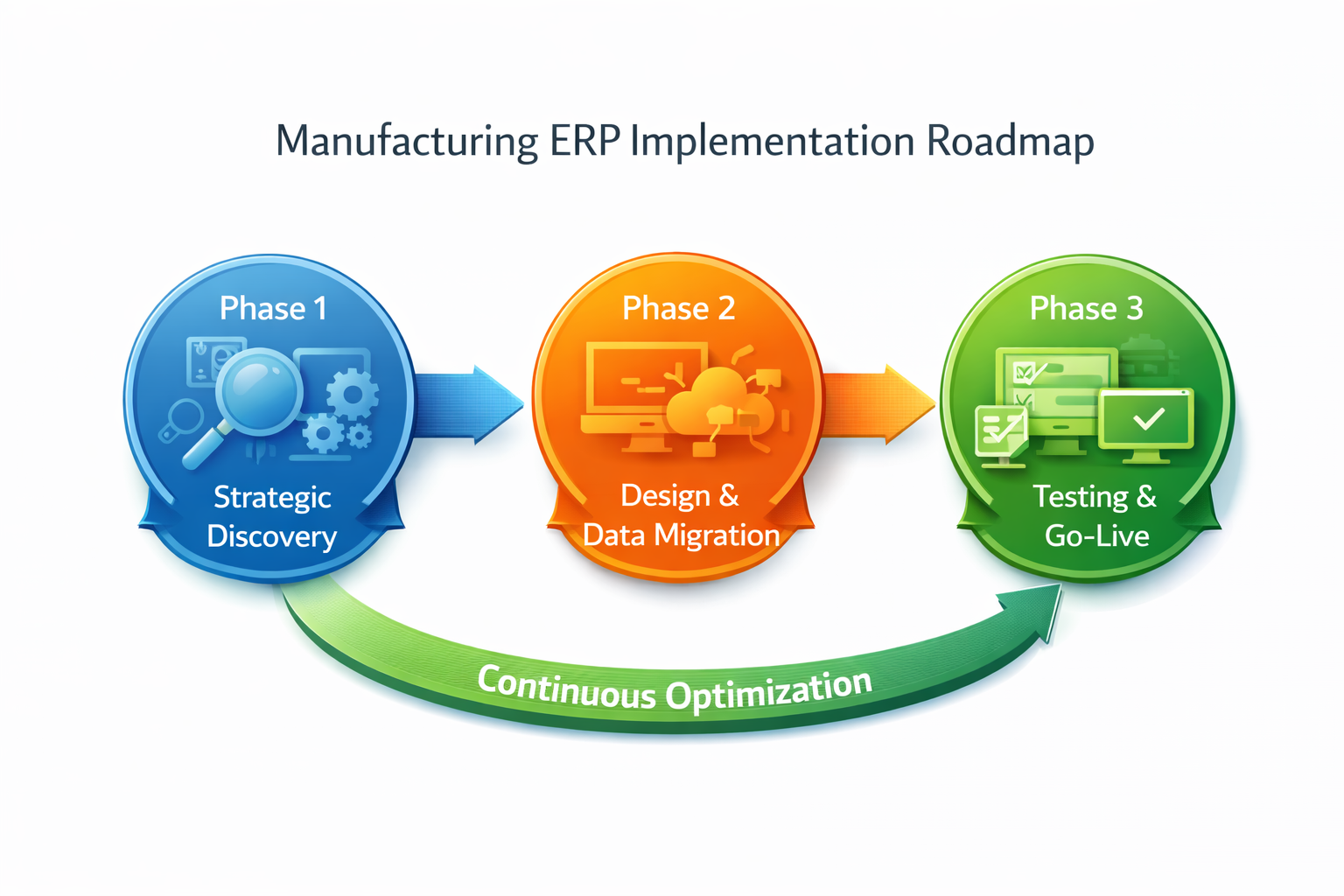
A successful ERP implementation requires a meticulously planned, multi-phased roadmap that guides the project from initial concept to post-launch optimization. Rushing the process is a primary cause of implementation failure; each phase builds on the last, ensuring alignment, minimizing risk, and maximizing user adoption.
Phase 1: Strategic Discovery and Process Mapping
Before building a solution, you must deeply understand the problems you're trying to solve. The discovery phase involves documenting and analyzing your current business processes, identifying bottlenecks, and defining clear, quantifiable objectives for the new ERP system. Instead of replicating old workflows in a new system, challenge your teams to envision optimized processes that leverage modern ERP capabilities. A key output should be a Business Requirements Document (BRD) that links every requested feature directly to a specific business outcome, such as reducing scrap by 5% or improving on-time delivery by 10%.
Phase 2: Design, Configuration, and Data Migration
With clear requirements in hand, the focus shifts to designing and configuring the ERP solution. The design process involves close collaboration between your project team and your ERP partner to translate business needs into system workflows and settings. Critically, this stage is also the time for data migration planning. Data is the lifeblood of any cloud-based ERP; develop a rigorous plan for cleansing, mapping, and migrating data from existing systems to ensure accuracy from day one. For example, a mid-sized discrete manufacturer we worked with dedicated an entire sprint to standardizing part numbers and bills of materials (BOMs) before migration, which prevented significant post-launch inventory management and production errors.
Phase 3: Testing, Training, and Go-Live
Thorough testing is essential for manufacturing ERP success. Beyond unit testing, include integration testing to verify that different modules work together seamlessly, and performance testing to ensure the system handles real-time manufacturing data without delays.
User Acceptance Testing (UAT) allows key end-users to run typical scenarios in a sandbox environment, confirming that workflows meet operational requirements. Parallel to testing, deploy a tailored training program focused on user roles and responsibilities within the new ERP. Incorporate hands-on practice in sandbox systems to build confidence. The go-live should be preceded by rehearsed cutover plans, and backed by a clear post-launch support framework to quickly resolve issues and stabilize operations.
Read more: ERP Data Migration Best Practices: 8 Steps for a Successful IFS Implementation
Establishing Strong Governance for Your ERP Project
An ERP project impacts every department, making strong governance essential to keep it on track, on budget, and aligned with strategic goals. A clear governance structure provides the framework for decision-making, accountability, and communication, preventing the project from being derailed by departmental politics or scope creep. Without it, even the best technology and project plan can fail.
Form a Cross-Functional Project Team
Your ERP project team must represent the entire manufacturing business, not just the IT department. The team should include an executive sponsor with budget authority, a dedicated project manager, and key stakeholders from finance, operations, engineering, supply chain management, and sales. Such cross-functional representation ensures all departmental needs are considered during the design and implementation process. A well-formed structure also turns key users into project champions who can help drive adoption within their respective departments.
Define Clear Roles, Responsibilities, and KPIs
Every member of the implementation team and steering committee must have a clearly defined role and set of responsibilities. Such clarity eliminates confusion and ensures accountability throughout the project lifecycle. Equally important is defining the Key Performance Indicators (KPIs) that will measure the project's success. The KPIs should be a mix of project-level metrics (e.g., on-time, on-budget) and business-level metrics (e.g., inventory turn rate, production cycle time, order-to-cash duration) that directly tie back to the objectives defined in the discovery phase.
Create a Data Governance Framework
An ERP software is useless if it's fed bad data. Establishing a data governance framework from the outset is one of the most critical implementation best practices. The framework defines ownership of key data domains (e.g., customer master, item master), sets standards for data entry and maintenance, and establishes processes for ensuring data quality over time. A strong framework ensures that the insights and reports generated by the cloud ERP are based on accurate and reliable information, which is fundamental to achieving your desired ROI.
Read next: IFS ERP for Smart Manufacturing: Integrating IoT, AI, & Industry 4.0
Mastering Change Management: The Human Side of Implementation
An ERP implementation involves both technology and people. Change management is the structured approach to managing the human side of the transition and is often the most underestimated component of the project. An effective change management strategy minimizes resistance, accelerates user adoption, and ensures your team can leverage the new system to its full potential.
Secure Visible Executive Sponsorship
The single most important factor in successful change management is active and visible sponsorship from senior leadership. The executive team must consistently communicate the project's strategic importance and lead by example. When employees see leadership's full commitment to the new system and its process changes, they are far more likely to embrace the transition. According to Prosci's research on organizational change, active sponsorship is the top contributor to success.
Communicate the "Why" Clearly and Consistently
Throughout the implementation process, communicate early and often with all affected employees. Your communication should focus on the "why" behind the change—how the new ERP will solve existing pain points, improve daily workflows, and contribute to the company's overall success. A well-planned communication strategy uses multiple channels and tailors messages to different audiences, addressing their specific concerns and highlighting the benefits most relevant to them. Such transparency builds trust and transforms employees from passive recipients of change into active participants.
Invest in Role-Based, Continuous Training
Effective training extends beyond a single go-live workshop. It should be role-based, focusing on the specific processes and tasks each user will perform in the new manufacturing ERP systems. Providing hands-on practice in a safe sandbox environment is crucial for building confidence. Furthermore, training shouldn't end at go-live. Plan for ongoing learning opportunities, create accessible documentation like quick-reference guides, and identify "super-users" within each department to provide peer-to-peer support. Investing in employee training is a direct investment in the long-term success of your ERP.
Future-Proof Your ERP Strategy
To maintain a competitive advantage, consider building your ERP roadmap around cloud-native solutions supporting scalability and remote accessibility. Incorporate emerging technology trends such as real-time edge computing for factory floor data processing, AI-driven predictive maintenance, and analytics embedded in IoT sensor data.
Additionally, plan for sustainability modules that track and reduce environmental impact, reflecting growing regulatory requirements and corporate responsibility goals. Strategic ERP platforms like IFS remain flexible enough to integrate these innovations while maintaining core operational stability. To explore a tailored IFS ERP strategy that fits your operational goals and long-term vision, schedule a call with Astra Canyon.
Why Manufacturers Choose Astra Canyon for Strategic ERP Roadmaps
Astra Canyon has earned trust by guiding manufacturers through complex ERP strategies and implementations that extend far beyond software setup. With decades of industry experience and hundreds of successful projects, our team understands both the operational demands of plant-floor environments and the strategic objectives of manufacturing leadership.
Companies such as Kodiak, PowerSecure, Barnhart, ESG, and HCR have turned to Astra Canyon to modernize ERP platforms, improve integration, and achieve measurable ROI. In one example, Nomad Global Communication Solutions replaced legacy systems with a modern ERP backbone, unifying operations and ensuring compliance. These results show how a strategic ERP roadmap can create lasting value for manufacturing organizations.
Want to learn more about platforms and partners that support this approach? Explore our top ERP systems for manufacturing guide.
 Blake Snider

 Blake Snider : Nov 20, 2025 12:00:00 AM