Aerospace and defense manufacturing operates under unique pressures that few other industries face. Engineer-to-order and make-to-order programs stretch across years, sometimes decades, requiring strict configuration control, regulatory compliance, and ITAR adherence at every stage.
Mixed-mode production environments must balance custom builds with standardized components while maintaining throughput and managing backlogs. Meanwhile, PLM systems hold the engineering truth—CAD models, BOMs, change orders, and certifications—while IFS Cloud serves as the ERP system of record for supply chain, project management, financials, and MRO. When these systems remain disconnected, manufacturers face duplicate data entry, limited visibility, compliance gaps, and operational friction that slows programs and increases risk.
A digital thread strategy connects PLM, CAD, and ERP solutions to centralize critical data, improve real-time visibility across departments, and support operational excellence from design through asset management.
TL;DR: Connecting PLM and IFS for A&D
-
A digital thread between PLM and IFS Cloud centralizes engineering, supply chain, and MRO data for lifecycle visibility.
-
Define scope and architecture first: decide which programs, products, and lifecycle stages to connect before selecting tooling.
-
Map critical data flows so engineering BOMs, change orders, and certifications move seamlessly between PLM and IFS Cloud.
-
Align workflows for change management, configuration control, and ITAR compliance to ensure traceability and audit readiness across departments.
-
Choose integration approaches—iPaaS, custom, or hybrid—based on volume, real-time needs, and scalability rather than vendor preference alone.
-
Phase deployment by program or product line to safeguard continuity, test thoroughly, and avoid disrupting active production schedules.
-
Monitor and optimize continuously so the digital thread supports advanced technologies like IoT, AI, and machine learning as programs evolve.
Why A&D Manufacturers Need a Connected PLM–IFS Digital Thread
Aerospace and defense manufacturing demands precision, traceability, and compliance across the full product lifecycle, from CAD design and prototyping to production, field deployment, and long-term asset management.
In aerospace and defense, engineer-to-order and ETO programs require engineering, supply chain, production, project management, and service teams to work from connected data. ITAR and other compliance requirements also make access control, documentation, and audit readiness essential.
That is where PLM, ERP, and IFS Cloud integration matter. PLM holds the engineering record, while IFS Cloud acts as the operational ERP system. Without seamless integration, teams face duplicate entry, version conflicts, delayed changes, and poor visibility across workflows.
A connected digital thread gives manufacturers real-time visibility across engineering and operations, helping them optimize schedules, control configuration changes, and support modular implementation. It also strengthens the foundation for AI, smarter ERP solutions, and predictive asset management, turning PLM and IFS Cloud into a connected backbone for compliant, agile manufacturing.
The Unique Requirements of A&D Manufacturing Programs
A&D manufacturing differs from high-volume production because programs are complex, long-lived, and often mixed-mode, with custom assemblies and standard parts managed together.
Engineer-to-order work requires close coordination across design, engineering, and manufacturing, especially when customer requirements, regulatory updates, or performance testing drive frequent changes. Make-to-order production must balance flexibility, throughput, quality, and delivery commitments.
Configuration management is critical when one platform has dozens of variants, each with its own certifications, compliance documentation, and lifecycle obligations. Asset management also extends far beyond delivery, as aerospace platforms remain in service for decades and require MRO support, parts traceability, and configuration tracking across operators and geographies.
When PLM and ERP systems operate in silos, engineering changes may not reach supply chain teams in time, production may work from outdated BOMs, and MRO teams may lack the certifications and configuration data needed to service assets compliantly. A&D manufacturing demands integration that supports lifecycle visibility, operational efficiency, and compliance without adding complexity or disruption.
Compliance Requirements, ITAR, and End-to-End Traceability
ITAR and regulatory compliance shape how aerospace and defense manufacturing data is stored, accessed, hosted, and documented. A digital thread between PLM and IFS Cloud must support these requirements from the start.
-
Critical data chain: Engineering drawings, BOMs, change orders, certifications, and test results must flow between PLM and ERP with full traceability so auditors can reconstruct decisions and verify compliance across the lifecycle.
-
Access controls and segregation: ITAR-controlled data must remain separate from non-controlled information, with role-based access enforced across PLM, IFS Cloud, and any integration middleware.
-
Audit trails and version control: Every BOM, configuration, or certification change must be logged, timestamped, and linked to the responsible user and approval workflow.
-
Decommission and MRO documentation: When assets are retired or transferred, the digital thread must preserve configuration history, maintenance records, and certifications for operators and regulators.
-
Real-time compliance monitoring: Integration should support compliance dashboards and alerts so teams can identify missing certifications, workflow gaps, or deviations before they cause audit findings or program delays.
When PLM and IFS Cloud are connected through a compliant digital thread, manufacturers can ensure compliance, reduce audit preparation time, and maintain the documentation rigor that aerospace and defense programs require.
From Siloed Systems to a Digital Thread Across Departments
In many A&D manufacturers, engineering, supply chain, production, and MRO teams use different systems, data, and workflows. Engineering owns PLM and CAD, where designs, BOMs, and change orders originate, while the supply chain manages procurement, inventory, and supplier relationships in the ERP system.
Production schedules work orders, tracks throughput, and manages shop floor execution. MRO teams maintain assets, manage service contracts, and ensure configuration compliance over decades. When teams depend on manual handoffs, spreadsheets, or periodic exports, critical data becomes stale or inconsistent.
Engineering changes may not reach the supply chain in time to adjust procurement. Production may build to outdated BOMs. MRO teams may lack the latest certifications or configuration data, creating compliance risk and service delays.
A digital thread replaces these silos with a connected, real-time flow of critical data across departments. PLM remains the source of engineering truth, and IFS Cloud remains the operational backbone, but integration ensures that changes, configurations, and lifecycle data move seamlessly between systems. The result is better visibility, faster decisions, fewer errors, and stronger operational efficiency without sacrificing compliance or product quality.
A Practical Integration Strategy for Connecting PLM and IFS Cloud
Connecting PLM and IFS Cloud in aerospace and defense manufacturing requires more than choosing an integration tool. It requires a clear strategy for scope, data flows, workflows, architecture, deployment, monitoring, and ongoing optimization.
The goal is to create a connected digital thread that supports compliance, lifecycle visibility, supply chain coordination, and operational efficiency without disrupting active programs.
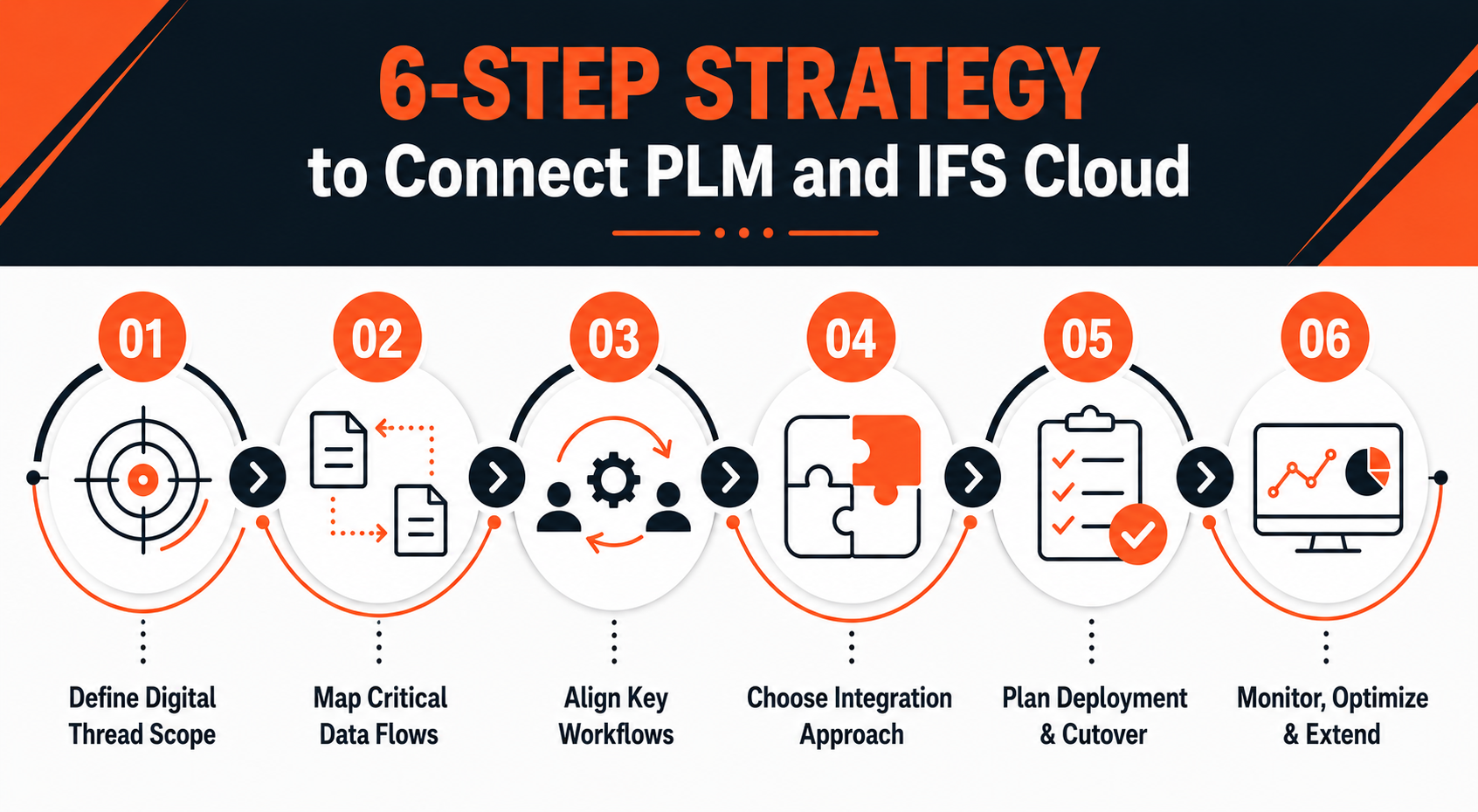
Step 1: Define the Digital Thread Scope and Target Architecture
Before selecting integration tooling or mapping data, define what the digital thread must accomplish. Clarify which programs, products, systems, and lifecycle stages it will support.
Starting with a clear scope prevents over-engineering, reduces implementation risk, and keeps stakeholders aligned from the start.
-
Identify pilot programs and products: Choose a manageable subset of engineer-to-order (ETO, or make-to-order programs to connect first, ideally those with active backlogs, compliance pressure, or visibility gaps that integration can address quickly.
-
Clarify lifecycle stages in scope: Decide whether the digital thread will initially cover design and production only, or extend to MRO, asset management, and decommission, then plan integration touchpoints accordingly.
-
Define system roles and ownership: Establish PLM as the system of record for engineering data, including CAD models, engineering BOMs, change orders, and certifications. Define IFS Cloud as the operational ERP system for manufacturing BOMs, supply chain, project management, financials, and MRO.
-
Map required integrations and patterns: Identify which systems must connect, including PLM to IFS Cloud, CAD to PLM, IoT platforms, MRO systems, and supplier portals. Decide whether each integration should run in real-time, near-real-time, or batch mode based on volume and workflow needs.
-
Choose a modular, scalable architecture: Design the integration so new programs, products, or lifecycle stages can be added without rework. This also allows advanced technologies like AI, machine learning, and IoT to be layered on later without disrupting the core digital thread.
Defining scope and architecture first ensures integration decisions align with business processes, compliance requirements, and long-term operational goals. It also prevents tooling limitations or vendor preferences from driving the strategy.
Step 2: Map Critical Data Flows Between PLM and IFS Cloud
The digital thread depends on moving the right data, in the right format, at the right time, between PLM and IFS Cloud. Clear data-flow mapping helps prevent duplication, version conflicts, compliance gaps, and manual re-entry across engineering, supply chain, production, and MRO.
Engineering BOMs should originate in PLM, where they reflect design intent, part specifications, revisions, and configuration rules. Manufacturing BOMs should live in IFS Cloud, where they include supplier parts, lead times, inventory availability, and production routing. Integration must translate engineering BOMs into manufacturing BOMs while preserving traceability, so changes in PLM propagate to the supply chain and production workflows without manual re-entry.
CAD metadata also needs a defined path. Part numbers, revisions, material specifications, and geometric tolerances should flow from CAD tools into PLM and then into IFS Cloud so procurement, production, and MRO teams work from the same source of truth. Change orders initiated in PLM should trigger workflows in IFS Cloud that update BOMs, adjust project schedules, notify supply chain teams of new part requirements, and log the change for audit and compliance purposes.
Configuration data and variant management rules defined in PLM must also be reflected in IFS Cloud so production builds the correct configuration, and MRO teams can identify which parts, certifications, and service procedures apply to each asset. Certifications, test results, and compliance documentation should be linked to the relevant parts, assemblies, and projects in both systems. Engineering data should remain governed in PLM, while operational data should remain governed in IFS Cloud, but field-level mapping ensures each system has the visibility needed to support compliance and operational efficiency from day one.
Step 3: Align Workflows for Change, Configuration, and Compliance
Data flows alone are not enough. Workflows must also be aligned so changes, configurations, and compliance controls move seamlessly between PLM and IFS Cloud.
This alignment prevents bottlenecks, errors, and audit gaps across aerospace and defense manufacturing programs.
-
Synchronize engineering change workflows: When an engineering change is approved in PLM, integration should automatically update the manufacturing BOM in IFS Cloud, notify the supply chain of new part requirements, adjust project schedules, and log the change with full traceability.
-
Ensure configuration and variant management consistency: Configuration rules and variant definitions in PLM must be reflected in IFS Cloud so production schedules, work orders, and MRO service contracts reference the correct configuration.
-
Build ITAR and regulatory compliance into workflows: Access controls, data segregation, and approval gates must be enforced across PLM, IFS Cloud, and integration middleware so ITAR-controlled data remains protected.
-
Automate compliance checks and alerts: Integration should trigger compliance checks when BOMs change, certifications expire, or configuration mismatches are detected. Real-time alerts help stakeholders resolve issues before they delay programs or create audit findings.
-
Preserve audit trails across systems: Every workflow action, including change approvals, BOM updates, certification uploads, and configuration changes, must be logged in both PLM and IFS Cloud with timestamps, user IDs, and approval chains.
Aligned workflows allow the digital thread to support operational efficiency and compliance at the same time. They also reduce manual intervention, errors, and disconnected processes that slow programs and increase audit exposure.
Step 4: Choose the Integration Approach and Tooling
Once scope, data flows, and workflows are defined, choose the integration approach that fits your architecture, volume, performance needs, and long-term scalability goals. The right approach should support current implementation priorities while leaving room for future optimization, lifecycle expansion, and additional ERP solutions.
iPaaS platforms offer pre-built connectors, visual workflow design, and cloud-native scalability, making them useful for organizations that need to connect multiple systems quickly through a managed service model. Native IFS integration capabilities, including APIs and built-in connectors, provide tight alignment with IFS Cloud and may reduce middleware needs, though complex workflows or non-standard PLM systems may still require custom development.
Custom integration built on APIs, web services, or message queues offers maximum flexibility and control. It allows manufacturers to match integration logic to exact business processes, compliance requirements, performance needs, and security controls, but it also requires more development effort and ongoing maintenance. Hybrid approaches can balance these needs by using iPaaS for standard flows and custom integration for complex, high-volume, or compliance-sensitive workflows.
Evaluation criteria should include data volume, frequency, real-time versus batch requirements, error handling, retry logic, monitoring, alerting, security, access controls, and scalability. Industry-specific needs also matter. A&D manufacturers need integration that supports ITAR compliance, configuration management, and long-lifecycle traceability, not just generic data synchronization. Choose tooling that can be documented, audited, maintained, and optimized over the lifecycle of the programs it supports, while also allowing AI, IoT, and machine learning capabilities to be introduced later.
Step 5: Plan Deployment, Testing, and Cutover to Avoid Disruption
Deployment strategy determines whether integration strengthens programs or creates disruption. A phased, well-tested approach protects continuity, maintains throughput, and builds stakeholder confidence.
For aerospace and defense programs, testing must cover data accuracy, workflow logic, compliance controls, and operational readiness before cutover.
-
Use phased deployment by program, product line, or plant: Start with a pilot program or product family, validate integration performance and data quality, then expand to additional programs incrementally so active schedules and backlogs are not disrupted.
-
Define testing strategies across the lifecycle: Test integration with real data, including engineering changes, BOM updates, configuration variants, and compliance workflows. Validate that data flows correctly from CAD through PLM to IFS Cloud and back to MRO.
-
Test compliance and audit scenarios: Simulate ITAR access controls, audit trail generation, certification tracking, and configuration traceability to confirm that integration supports regulatory compliance.
-
Establish readiness checkpoints before cutover: Verify data quality in both PLM and IFS Cloud, confirm users are trained, validate monitoring and error handling, and secure stakeholder sign-off from engineering, supply chain, production, and MRO.
-
Plan cutover timing to minimize risk: Schedule cutover during lower-volume periods, avoid critical program milestones, and maintain parallel systems or rollback plans so operations can continue if issues arise.
Phased deployment and rigorous testing reduce risk while protecting throughput. They also help ensure the digital thread delivers operational efficiency and compliance benefits without delaying programs.
Step 6: Monitor, Optimize, and Extend the Digital Thread
Integration is not a one-time project. Ongoing monitoring, optimization, and extension ensure the digital thread continues to support operational excellence as programs evolve, volumes grow, and new technologies are introduced.
Start by monitoring integration performance and data quality across PLM and IFS Cloud. Track data flow volumes, error rates, latency, and workflow completion times so issues can be resolved before they affect operations. At the same time, flag mismatches, missing certifications, and configuration inconsistencies before they create compliance gaps, production delays, or MRO issues.
As usage patterns become clear, optimize workflows and data mappings based on real-world needs. This may include refining field mappings, adjusting batch schedules, improving error handling, or adding real-time triggers where delays and manual steps are creating bottlenecks for engineering, supply chain, production, or MRO teams.
The digital thread should also extend as programs mature. Manufacturers can add new lifecycle stages, products, and systems, including IoT platforms for predictive maintenance, AI-driven scheduling optimization, and machine learning models that analyze asset performance and recommend improvements. Because advanced technologies like IoT, AI, and machine learning depend on clean, centralized, real-time data, optimization should be treated as a lifecycle effort, not a one-time task.
Read Next:
Readiness Checklist and Risk Controls for A&D PLM–IFS Integration
Before launching integration, assess organizational, data, security, and technical readiness. This helps identify gaps, reduce risk, and ensure deployment proceeds smoothly without disrupting operations or creating compliance exposure.
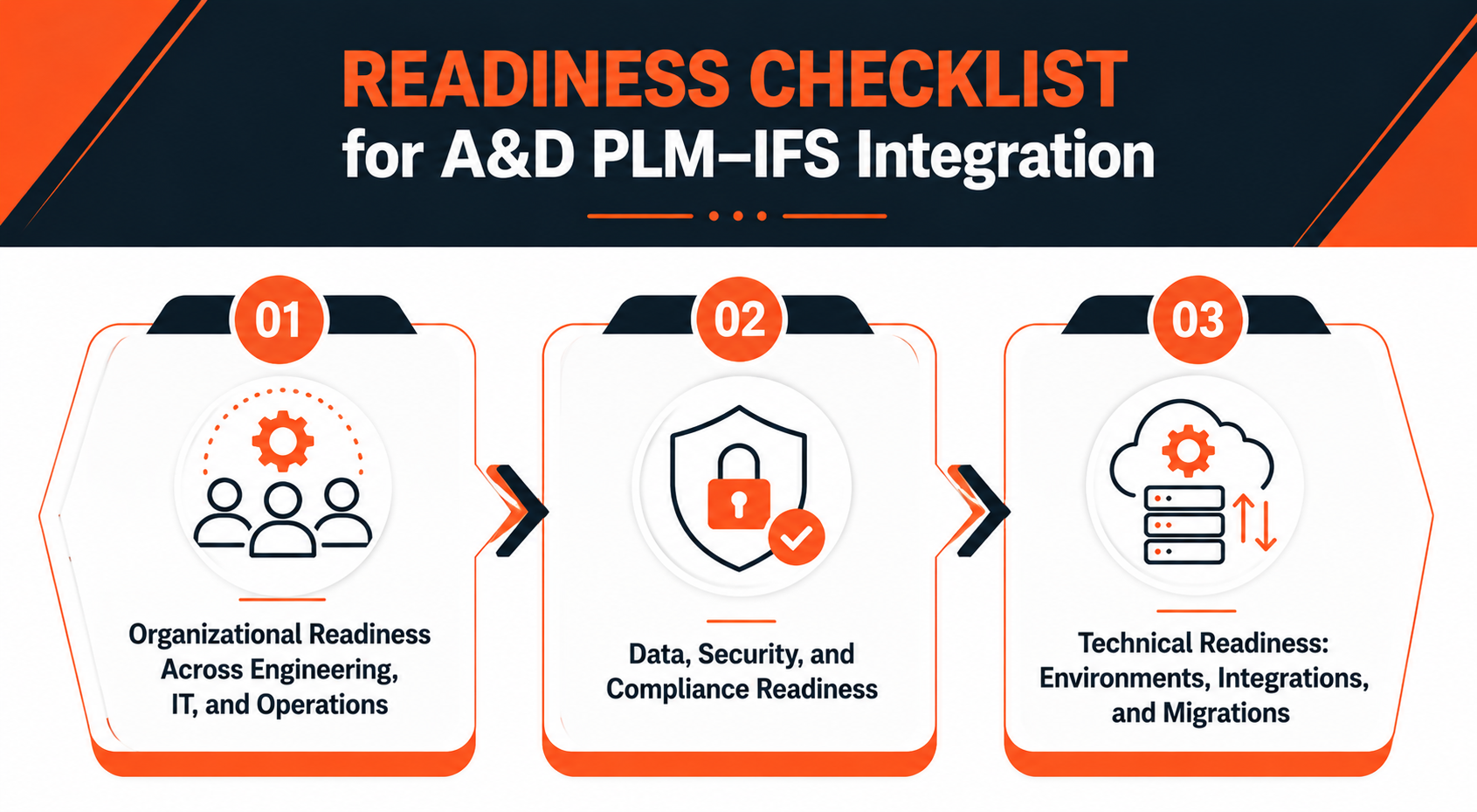
Organizational Readiness Across Engineering, IT, and Operations
Successful integration depends on alignment, ownership, and capacity across departments. Before committing to deployment timelines, confirm that engineering, IT, supply chain, production, and MRO leaders agree on scope, priorities, success criteria, and executive sponsorship.
- Stakeholder alignment and sponsorship: Confirm that engineering, IT, supply chain, production, and MRO leaders agree on scope, priorities, and success criteria, and that executive sponsorship is in place to resolve conflicts and allocate resources.
- Ownership of workflows and data: Clarify who owns each workflow, who is responsible for data quality in PLM and IFS Cloud, and who will manage integration monitoring, error resolution, and optimization after go-live.
- Skills and capacity for complex projects: Verify that IT and engineering teams have the skills to design, implement, and maintain integration, or plan to engage an integration partner with A&D experience and IFS Cloud expertise.
- Governance structures and decision-making: Establish governance processes for managing integration changes, resolving data conflicts, and prioritizing new features or lifecycle stages so the digital thread can evolve without bottlenecks or rework.
Organizational readiness ensures the integration has the support, resources, and decision-making structure needed to succeed. It also helps stakeholders prepare for the new workflows, responsibilities, and cross-departmental processes that come with a connected digital thread.
Data, Security, and Compliance Readiness
Integration quality depends on the quality of the data being integrated and the security controls protecting it. Before deployment, validate PLM and ERP data quality so incomplete BOMs, missing part numbers, outdated certifications, or inconsistent configuration data do not propagate through the digital thread.
Clean, classify, and validate data in both PLM and IFS Cloud before connecting them. ITAR and regulatory compliance requirements must also be built into the integration design from the start, with access controls, data segregation, and audit logging configured across PLM, IFS Cloud, and integration middleware.
Security readiness should include identity and access management, encryption in transit and at rest, and monitoring for unauthorized access or data exfiltration. These controls help ensure ITAR-controlled data remains protected and that every data transfer, change, and access event is logged for audit purposes.
Before going live, test security and compliance controls as part of deployment readiness. The integration should not create new vulnerabilities, weaken access controls, or introduce compliance exposure across engineering, supply chain, production, or MRO workflows.
Technical Readiness: Environments, Integrations, and Migrations
Technical readiness determines whether integration can be deployed, tested, and maintained without disrupting operations or creating technical debt. Confirm the deployment model first, including whether IFS Cloud and PLM are hosted on-premises, in the cloud, or in a hybrid environment.
- Confirm deployment models and connectivity: Verify that network connectivity, latency, and security controls support the integration architecture and performance requirements.
- Inventory existing integrations and customizations: Document existing integrations, customizations, and legacy systems that may conflict with or depend on PLM or IFS Cloud, then plan how they will be retired, replaced, or adapted during deployment.
- Assess migration and cutover complexity: If integration requires data migration, BOM restructuring, or workflow changes, assess the timeline, risk, and testing required to protect continuity and throughput during cutover.
- Validate monitoring and error-handling capabilities: Ensure the integration includes real-time monitoring, error logging, alerting, and retry logic so issues can be detected and resolved quickly without manual intervention or operational disruption.
Technical readiness gives IT and engineering teams the tools and visibility needed to manage the digital thread reliably. It also ensures the integration can support the lifecycle of the A&D programs it connects, not just the initial implementation.
Read Next: Aerospace ERP Buyers Guide: Choosing a Flexible Aviation Maintenance ERP
Bringing the Digital Thread to Life in A&D Manufacturing
A connected PLM–IFS Cloud digital thread is a strategy for aligning engineering, supply chain, production, and MRO around a shared source of truth that supports complex projects, regulatory compliance, and long-lifecycle asset management.
When PLM and IFS Cloud are connected through a resilient digital thread, manufacturers gain the visibility, agility, and control needed to manage backlogs, maintain throughput, and deliver operational excellence without sacrificing compliance or product quality.
- Start with lifecycle and workflow first, then choose integration tooling: Define scope, map data flows, and align workflows before selecting iPaaS, custom, or hybrid integration approaches so the architecture fits business processes rather than the reverse.
- Treat compliance and ITAR as design inputs, not afterthoughts: Build access controls, audit trails, and data segregation into integration from the start so traceability and audits remain straightforward, and compliance gaps do not delay programs.
- Build a phased, scalable digital thread so you can add AI, IoT, and optimization without rework: Deploy incrementally, monitor continuously, and design integration to support advanced technologies and new lifecycle stages as programs evolve and operational needs change.
Astra Canyon helps aerospace and defense manufacturers design and implement integration between IFS Cloud and PLM, CAD, and other engineering systems. Their IFS ERP Integration service covers integration architecture, authentication mechanisms, field mapping, error handling, and performance optimization, supporting complex, custom implementations that align with A&D operational requirements and compliance needs.
Plan your PLM integration to align IFS Cloud and engineering systems, improve lifecycle visibility, and strengthen compliance across programs.
FAQs
How Should A&D Manufacturers Decide Which Data Lives in PLM Versus IFS Cloud?
PLM should remain the system of record for engineering data: CAD models, engineering BOMs, design specifications, change orders, and certifications that reflect design intent and configuration rules. IFS Cloud should own operational data: manufacturing BOMs, supply chain information, project schedules, financials, work orders, and MRO records that support production, procurement, and asset management.
What Are the Biggest Risks When Integrating PLM and ERP Systems in Aerospace and Defense Manufacturing?
The biggest risks include poor data quality, which propagates errors and compliance gaps across the digital thread; misaligned workflows, which create bottlenecks, delays, and manual workarounds; inadequate ITAR and compliance controls, which expose manufacturers to audit findings and regulatory penalties; and deployment disruption, which impacts throughput, backlogs, and program schedules.
How Can PLM–IFS Integration Help Ensure ITAR and Regulatory Compliance Across the Lifecycle?
PLM–IFS integration supports ITAR and regulatory compliance by centralizing critical data, enforcing access controls, and preserving audit trails across the lifecycle. When engineering changes, BOMs, certifications, and configuration data flow between PLM and IFS Cloud through a compliant digital thread, manufacturers can ensure that ITAR-controlled information remains segregated, that every change is logged with timestamps and approvals, and that compliance documentation is linked to the correct parts, assemblies, and assets
What Is a Realistic Deployment Timeline for Connecting PLM and IFS Cloud in A&D?
Deployment timelines vary based on scope, complexity, data quality, and organizational readiness. A pilot integration connecting a single program or product line typically takes three to six months, including scope definition, data mapping, workflow alignment, integration development, testing, and cutover. Expanding integration to additional programs, lifecycle stages, or systems may take six to twelve months or longer, depending on the number of data flows, compliance requirements, and customizations needed.
How Does a Digital Thread Improve MRO and Asset Management for Long-Lifecycle Aerospace Assets?
A digital thread improves MRO and asset management by providing real-time access to configuration data, certifications, maintenance history, and engineering documentation across the lifecycle. When PLM and IFS Cloud are connected, MRO teams can identify which parts, certifications, and service procedures apply to each asset based on its configuration and variant, reducing errors and ensuring compliance.
Can Existing CAD and PLM Tools Be Integrated with IFS Cloud Without Full System Replacement?
Yes, existing CAD and PLM tools can be integrated with IFS Cloud without full system replacement. Integration can be designed to connect current systems using APIs, web services, iPaaS platforms, or custom middleware, allowing manufacturers to preserve investments in CAD and PLM while gaining the operational efficiency and lifecycle visibility that a digital thread provides.
How Do Advanced Technologies Like IoT and AI Fit Into a PLM–IFS Digital Thread Strategy?
Advanced technologies like IoT and AI depend on clean, centralized, real-time data, which a well-designed digital thread provides. IoT platforms can be integrated with the digital thread to capture sensor data from assets, production equipment, and field deployments, feeding real-time performance metrics into IFS Cloud for predictive maintenance, asset management, and operational optimization.
 Blake Snider

 Eric Smith : Dec 1, 2025, 12:00:00 AM

 Blake Snider