 Blake Snider
IoT Integration with ERP Systems: Transforming Manufacturing Efficiency
 Blake Snider : Aug 21, 2025, 12:45:26 PM
See how integrating IoT with ERP systems boosts real-time data, production visibility, and control in manufacturing.
IFS and GIS integration connects utility asset management, field service, and work management data with geographic information system records so teams can locate assets, visualize work orders, and manage field operations with greater geographic context. For utilities using IFS Cloud and Esri GIS, the goal is to connect operational workflows with accurate GIS data, utility mapping, and utility network information.
This matters because utility operations depend on location. A transformer, pole, meter, valve, feeder, substation asset, or DER interconnection is not just an asset record. It exists within a utility network that requires maintenance, inspection, outage response, and long-term lifecycle management. When GIS and work management systems operate separately, teams often struggle with duplicate data entry, inconsistent asset records, reduced visibility, and slower decision-making across maintenance and network operations.
A successful IFS and GIS integration does more than connect systems. It helps utilities align asset data, work orders, field activities, and spatial information, so planners, dispatchers, field crews, and asset managers can work from a more complete view of the network and the assets it supports.
IFS and GIS integration connects IFS Cloud to a geographic information system, typically Esri GIS or Esri Utility Network, so that asset data, work orders, inspection records, and spatial information can flow between systems. The goal is not simply to exchange data. It is to connect utility asset management, work management, and field operations with the geographic context required to support day-to-day utility operations.
In most utility environments, GIS and enterprise asset management serve different but complementary purposes. GIS helps organizations understand where assets exist and how they connect within the utility network. IFS helps organizations manage the work required to inspect, maintain, repair, and operate those assets. Integration ensures both systems remain aligned so teams can work from a shared view of assets, work orders, and network information.
| Function | Esir GIS | IFS Cloud |
|---|---|---|
| Primary Role | System of record for geographic information and utility mapping | System of record for work management and asset operations |
| Asset Location | Maintains spatial data, coordinates, and network relationships | References location information for maintenance and field work |
| Utility Network Management | Models network connectivity and geographic relationships | Supports maintenance and operational activities tied to network assets |
| Work Orders | Provides geographic context for work | Creates, schedules, executes, and tracks work orders |
| Asset Maintenance | Supports asset visualization and analysis | Manages inspections, maintenance, and asset lifecycle activities |
| Field Operations | Provides map-based location intelligence | Supports dispatching, field service, and work execution |
| Reporting and Analysis | Supports spatial analysis and network insights | Supports operational, maintenance, labor, and cost reporting |
| Core Value | Understanding where assets are and how they connect | Managing the work required to operate and maintain assets |
Together, these systems help utilities connect geographic information with operational execution. GIS provides the location intelligence. IFS provides the workflows, maintenance processes, and work management capabilities needed to act on that information.
For many utilities, IFS Cloud serves as the operational platform where maintenance activities, inspections, work orders, field service activities, inventory coordination, and asset management processes are planned and executed. It helps utilities coordinate the work required to maintain infrastructure reliability while providing visibility into asset condition, labor utilization, materials consumption, and maintenance history.
The value of IFS increases significantly when operational records are connected to the geographic and network information maintained within GIS. Maintenance decisions become more effective when planners, dispatchers, and field crews can see not only what work needs to be performed, but also where assets are located and how they relate to the broader utility network.
Esri GIS often acts as the geographic foundation for utility operations. It stores asset locations, network connectivity, spatial relationships, and utility mapping information that helps organizations understand how infrastructure is configured across their service territory.
GIS becomes particularly valuable during activities such as outage response, inspection planning, vegetation management, asset replacement programs, and capital planning. By combining spatial analysis with network data, utilities can evaluate geographic risk, identify affected infrastructure, and better understand how individual assets support the larger utility network.
Utilities connect IFS and GIS because operational work depends on geographic context. Work orders, inspections, outage response, and maintenance planning all become more effective when asset records, work management processes, and spatial information remain connected.
When IFS Cloud and Esri GIS are integrated, utilities can visualize work orders on maps, improve dispatching and crew routing, reduce duplicate data entry, improve data accuracy, and support more coordinated field operations. More importantly, they can align enterprise asset management with utility mapping and network intelligence, creating a more complete operational view of the assets they maintain and the networks they operate.
The benefits of GIS integration extend far beyond mapping. The real value comes from connecting geographic information with operational execution so teams can make better decisions, maintain stronger data integrity, and operate from a more accurate view of the network.
Disconnected GIS and IFS environments create operational friction. Teams may still complete the work, but they often rely on manual updates, spreadsheets, screenshots, phone calls, or duplicate records. Over time, those workarounds weaken data integrity, slow field execution, and make utility operations harder to scale.
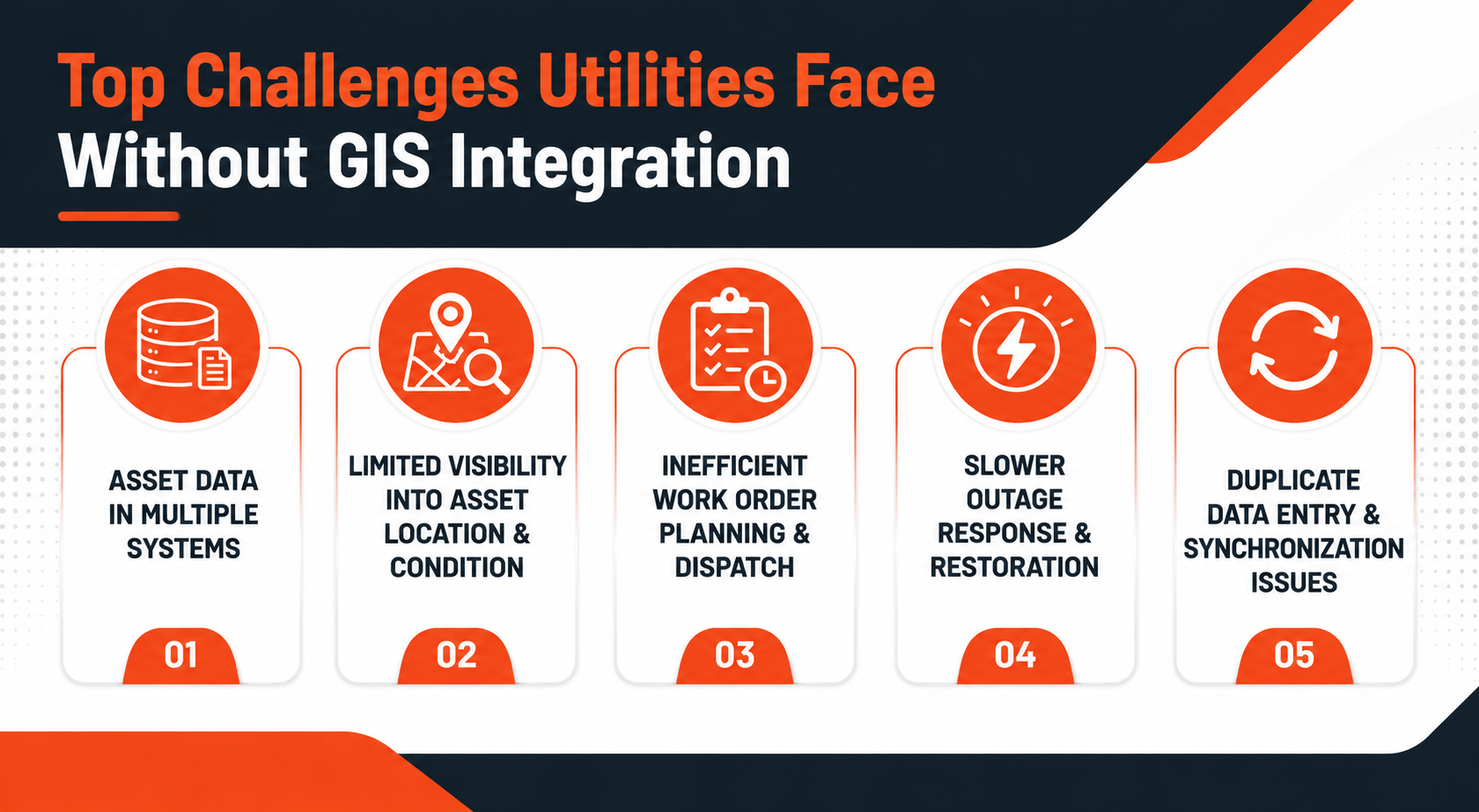
Many utilities store overlapping asset data in both GIS and enterprise asset management systems. GIS may hold location, network connectivity, and geographic data, while IFS holds work history, maintenance plans, costs, and asset condition.
Problems appear when those records no longer match. A transformer may exist in the GIS database, but the related IFS asset record may use a different name, ID, location, or status. When teams cannot trust which system has the correct record, work planning becomes slower, and data management becomes harder.
Utilities should clarify which system owns each asset attribute, how asset IDs are matched, how as-built updates move into operational records, and how retired, replaced, or relocated assets are updated.
IFS may show asset condition, maintenance history, and open work orders, while GIS shows where those assets exist in the utility network. When the systems are disconnected, decision-makers lose the ability to connect condition and location in one view.
That gap affects maintenance planning, outage response, inspections, and capital planning. A high-risk asset matters more when teams can see that it supports a critical feeder, sits in a storm-prone area, or affects a large customer zone.
Work order planning depends on location, priority, crew skills, materials, access constraints, and field conditions. Without GIS integration, planners often switch between IFS and GIS to understand where work is located and how jobs relate geographically.
That creates avoidable friction. Field crews may receive incomplete location context, dispatchers may miss opportunities to group nearby work, and maintenance teams may struggle to optimize routes across large or rural service territories.
Outage response requires fast coordination across OMS, GIS, field crews, inventory, customer communication, and work management systems. If GIS and IFS are disconnected, restoration work may depend on manual handoffs between outage maps and work order processes.
That can slow crew assignment, restoration planning, and follow-up maintenance. Utilities should verify how outage data, asset records, work orders, and field updates move across systems before relying on manual coordination during storm or emergency events.
Duplicate data entry creates risk. Every manual update is an opportunity for data accuracy problems, missed fields, inconsistent attribute data, or outdated records.
Common issues include asset locations updated in GIS but not IFS, work order statuses updated in IFS but not visible in GIS, inspection data that is not linked to the right asset, delayed as-built updates, mismatched data formats, and network data that never reaches operational planning.
A seamless integration should reduce manual entry, but only when the data model, ownership rules, and integration process are clearly designed.
The business benefits of GIS integration come from connecting location intelligence with operational execution. For utilities, that means better visibility into assets, stronger coordination between teams, and more reliable data flows across enterprise asset management, field service, and network operations.
Rather than forcing users to move between disconnected systems, an integrated IFS and GIS environment creates a more complete view of assets, work, and infrastructure. That visibility becomes increasingly important as utilities modernize their networks, manage aging assets, and support more complex field operations.
Key areas where utilities typically see value include:
While the specific benefits vary by organization, most utilities see value in five key areas: asset visibility, work management, field operations, outage response, and lifecycle management.
Integrating GIS with IFS helps teams view asset records within their geographic context. Instead of reviewing assets solely through maintenance records or work order screens, users can see where assets are located, how they connect to the utility network, and what surrounding conditions may influence maintenance decisions.
This additional context can improve maintenance prioritization, inspection planning, vegetation management activities, storm preparedness efforts, and long-term capital planning. Asset condition becomes more meaningful when it can be evaluated alongside location, network criticality, and operational risk.
Work order planning becomes more effective when maintenance activities can be evaluated geographically. Planners can identify nearby jobs, understand access constraints, and coordinate work across specific service territories or network segments.
For utilities managing large geographic footprints, this can help reduce unnecessary travel, improve crew utilization, and support more consistent scheduling practices. It also gives planners additional context when prioritizing work based on asset criticality, outage risk, or location-specific conditions.
Field crews rely on accurate information to perform work safely and efficiently. When GIS and IFS operate separately, crews may need to switch between systems or rely on manual updates to confirm asset locations, inspection history, or network information.
An integrated environment gives field personnel access to the geographic and operational data they need in a single workflow. This can help crews locate assets more quickly, update work records more accurately, and spend less time searching for information before work begins.
Outage response depends on timely coordination between operations, field crews, asset management teams, and customer-facing functions. During restoration efforts, utilities need visibility into affected assets, work status, crew assignments, and network conditions.
IFS and GIS integration can help support this coordination by connecting work management activities with utility mapping and network information. While GIS, OMS, and IFS each serve different purposes, integration helps ensure critical operational data remains aligned throughout the restoration process.
Utilities are often required to maintain accurate records related to inspections, maintenance activities, asset condition, and regulatory compliance. When GIS and enterprise asset management data exist in separate systems, reporting can become more difficult and time-consuming.
Integration helps create stronger traceability by connecting asset location, maintenance history, inspection records, status changes, and supporting documentation. Organizations should still verify their specific regulatory requirements, but integrated data typically provides a stronger foundation for reporting and audit preparation.
Utility assets move through a long lifecycle that includes planning, construction, commissioning, operation, maintenance, replacement, and retirement. Throughout that lifecycle, both GIS and IFS capture information that supports operational decision-making.
A well-designed integration helps ensure important updates are reflected across both systems, reducing the risk of conflicting records or outdated information. This supports stronger data integrity, more reliable planning, and better long-term management of utility infrastructure.
Read More: A Deep Dive into IFS Cloud for Enterprise Asset Management (EAM)
The most successful IFS and GIS integration projects start with focused business use cases rather than broad system-to-system data synchronization. Trying to connect every asset record, workflow, and data point at once can create unnecessary complexity. Utilities typically see the greatest value by starting with workflows that improve visibility, work execution, data quality, and field coordination.
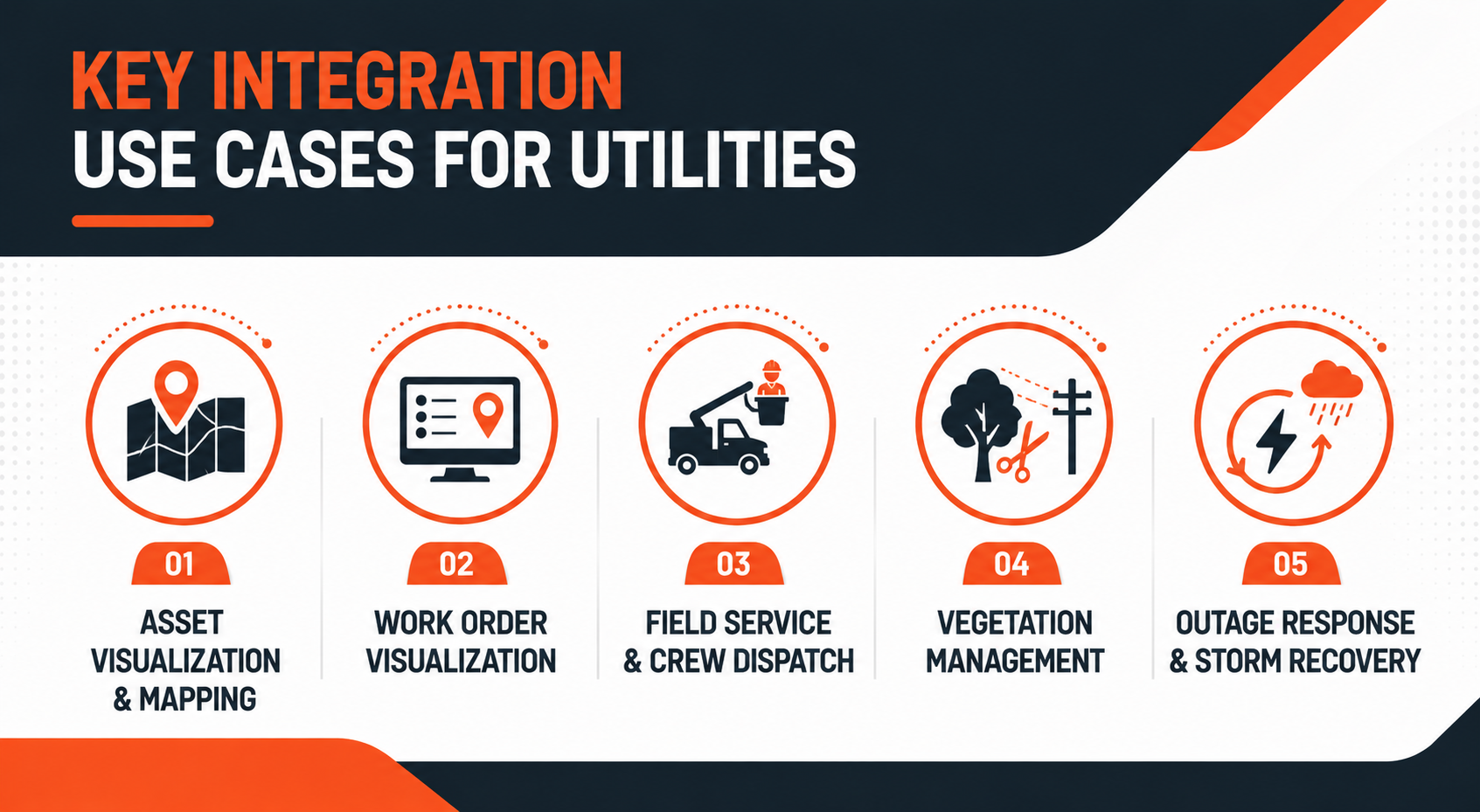
Asset visualization is often the first use case utilities pursue because it connects IFS asset records with GIS mapping. Teams can see where assets are located, how they relate to the utility network, and whether open work, inspection findings, or asset condition issues are concentrated in specific areas.
For example, a planner may want to view transformers with open maintenance work, poles with recent inspection findings, or assets due for replacement in a specific district. This use case depends on consistent asset identifiers between IFS and GIS. Without reliable cross-references, map views can quickly become incomplete or inaccurate.
Critical infrastructure mapping adds another layer of value. Assets supporting hospitals, substations, industrial customers, major feeders, or high-risk areas may require different inspection and maintenance strategies. GIS spatial analysis can help identify location-based risk, while IFS supports the work execution, asset history, and maintenance records needed to act on that risk.
Work order visualization connects IFS work management with GIS mapping so planners, supervisors, and field crews can see work geographically instead of reviewing open tasks only in lists or reports. This helps teams understand where work is concentrated, where crews may be overloaded, and where nearby tasks can be coordinated.
This use case is especially valuable when work priority depends on geographic risk. A routine inspection may become more urgent if the asset is near a known outage area, wildfire risk zone, critical customer route, or storm-affected region. By combining spatial data with operational records, utilities can prioritize work with better context and make more informed scheduling decisions.
Utilities should also evaluate which map layers are truly useful. Open corrective work, preventive maintenance, inspections, emergency work, crew assignments, asset condition indicators, weather data, and access restrictions may all add value, but too many layers can overwhelm users. The goal is practical decision support, not a crowded map.
Field service depends on sending the right crew to the right location with the right information. GIS integration improves dispatch by connecting geographic information, work order status, asset access points, and field execution data in a more usable workflow.
Crew routing becomes more effective when dispatchers can see work locations, crew availability, nearby jobs, and network conditions together. This can help streamline planning and reduce unnecessary travel, especially across large or rural service territories. Utilities should confirm whether routing decisions require real-time data or whether scheduled updates are sufficient. The right approach depends on operational requirements, network conditions, and field service maturity.
The larger goal is not simply reducing travel time. It is improving operational efficiency by giving planners and crews better location data, clearer work packages, and fewer manual coordination steps.
Vegetation management is a strong GIS integration use case because it depends heavily on location, network proximity, inspection findings, and risk prioritization. GIS can help identify where vegetation risk intersects with overhead lines, rights-of-way, weather exposure, and historical outage patterns.
IFS can then manage the resulting work orders, schedules, service providers, permits, inspections, and follow-up activities. This is especially useful when utilities coordinate internal crews and external contractors across broad service territories.
Integration helps reduce the disconnect between map-based risk identification and actual maintenance execution. Instead of identifying risk in GIS and managing the work separately, utilities can connect the risk, the asset, the work order, and the completion record.
Outage response and storm recovery require fast coordination across GIS, OMS, IFS, field service tools, weather data, inventory, and communication workflows. GIS can help visualize impacted assets, affected circuits, service territories, and nearby infrastructure. IFS can help manage the work orders, crews, materials, inspections, and follow-up maintenance needed to support restoration.
The integration should support practical restoration workflows without overwhelming users with unnecessary data. During storm events, teams need clear views of what is affected, what work is assigned, what materials are needed, and what has already been completed.
Utilities should also evaluate how field updates move back into IFS and GIS after restoration. Accurate post-event records are important for asset condition updates, regulatory reporting, future planning, and long-term network reliability.
Read More: Why Utilities Are Turning to IFS for Distributed Energy Resources
Data flows are at the heart of any IFS and GIS integration. Before selecting integration tools or designing interfaces, utilities need to define what data moves between systems, when it moves, which platform owns it, and how exceptions are handled.
The goal is not to synchronize every available data point. Effective integrations focus on the information required to support asset management, field operations, work execution, and operational reporting while maintaining clear ownership of critical records.
Asset synchronization is often the foundation of an IFS and GIS integration. This data may include asset identifiers, asset types, locations, status, hierarchy information, installation dates, and selected attribute data.
In many utility environments, GIS owns spatial location and network connectivity information, while IFS manages maintenance history, work management records, and operational asset data. The most important decision is not what data moves between systems, but which system owns each data element.
Utilities should establish clear rules for asset matching, validation, update frequency, exception handling, asset retirement, replacement processes, and as-built updates before integration development begins.
Work order synchronization allows GIS users to see operational activities in geographic context while enabling IFS users to benefit from network visibility and location intelligence.
Typical integrations share information such as work order status, priority, location, assigned crew, work type, scheduled dates, and completion details. This helps planners, supervisors, and field teams understand not only what work is occurring, but where it is occurring.
Utilities should determine whether work order visibility requires real-time updates or whether near-real-time synchronization is sufficient for operational needs.
Service requests and inspection records often originate from customer reports, planned maintenance programs, field inspections, or outage-related activities. These records become significantly more valuable when they can be connected to the correct asset, work order, and geographic location.
Utilities should pay particular attention to how inspection data is captured, validated, and maintained. Inaccurate or incomplete inspection records can weaken asset condition analysis and reduce confidence in maintenance planning decisions.
Spatial data provides the geographic context that supports utility operations. This may include asset coordinates, network relationships, service territories, circuits, feeders, map layers, and other location-based information.
Not all GIS data belongs inside IFS. Attempting to replicate the entire GIS database within an enterprise asset management platform often adds unnecessary complexity. Instead, utilities should focus on providing the geographic information required to support planning, maintenance, field execution, reporting, and decision-making.
Read More: IFS Cloud for Distributed Energy Resource Management
Not every data flow requires the same synchronization method. Some operational processes benefit from real-time updates, while others can be managed through scheduled synchronization.
For example, outage response activities, crew dispatching, and critical field updates may require real-time data exchange. Asset attributes, reference data, and lower-priority updates may be better suited for scheduled batch processing.
Most utility integrations use a combination of both approaches. The objective is to align the integration design with business requirements rather than applying a single synchronization model to every data flow.
Successful IFS and GIS integration projects are rarely limited by technology. More often, challenges emerge from unclear ownership, inconsistent data, weak governance, or poorly defined processes. Before selecting integration tools or building interfaces, utilities should establish the operational and organizational foundations needed to support long-term success.
One of the most important decisions in any integration project is determining which system owns which data. In most utility environments, GIS serves as the system of record for geographic location, network connectivity, and spatial information, while IFS manages work orders, maintenance history, asset condition, and operational records.
Without clearly defined ownership, integrations can create conflicting updates, duplicate records, and uncertainty about which system contains the most accurate information. Defining ownership at the data-field level helps protect data integrity and reduces confusion as the integration evolves.
GIS and IFS often represent assets differently because they serve different operational purposes. GIS focuses on network relationships and geographic connectivity, while IFS focuses on maintainable assets, work management, and lifecycle activities.
Utilities should evaluate how these models relate and where alignment is required. A one-to-one relationship is not always realistic, but the integration should accurately reflect how assets are managed, maintained, and operated within the organization.
Data governance defines how information is created, updated, validated, approved, and retired. Strong governance protects data quality across both systems and reduces the likelihood of inconsistent records.
This includes standards for asset identifiers, naming conventions, required attributes, validation rules, approval processes, and ongoing data stewardship. Integration projects often expose existing data quality issues, making governance a critical component of long-term success.
Both GIS and IFS may contain sensitive operational information that requires appropriate security controls. Integration planning should address user access, authentication methods, audit logging, service accounts, and interface security requirements.
Utilities should work closely with IT, cybersecurity, and compliance teams to ensure integration requirements align with broader organizational policies. Security considerations should be incorporated into the design process rather than addressed after implementation.
Performance expectations should be defined before integration development begins. Large utility environments can generate significant volumes of asset, work order, inspection, and spatial data, particularly when real-time updates are required.
Teams should test performance using realistic data volumes and operational scenarios. Testing with limited sample data often fails to reveal issues that appear once the integration is operating at scale.
An integration should support future business needs, not just current requirements. As utilities continue to modernize operations, additional systems, data sources, and workflows may need to be connected.
Organizations should evaluate how the integration will support future initiatives such as distributed energy resources, EV charging infrastructure, advanced analytics, mobile workforce solutions, weather data integration, and other emerging technologies. Designing for scalability today can help reduce future rework and support long-term operational flexibility.
Read Next: IFS Integration Project Best Practices: What to Know Before You Start
Utilities often make the mistake of treating GIS integration as a technology project. In reality, successful integrations begin with operational objectives, clear ownership, and well-defined processes. A phased approach helps organizations deliver value faster while reducing implementation risk.
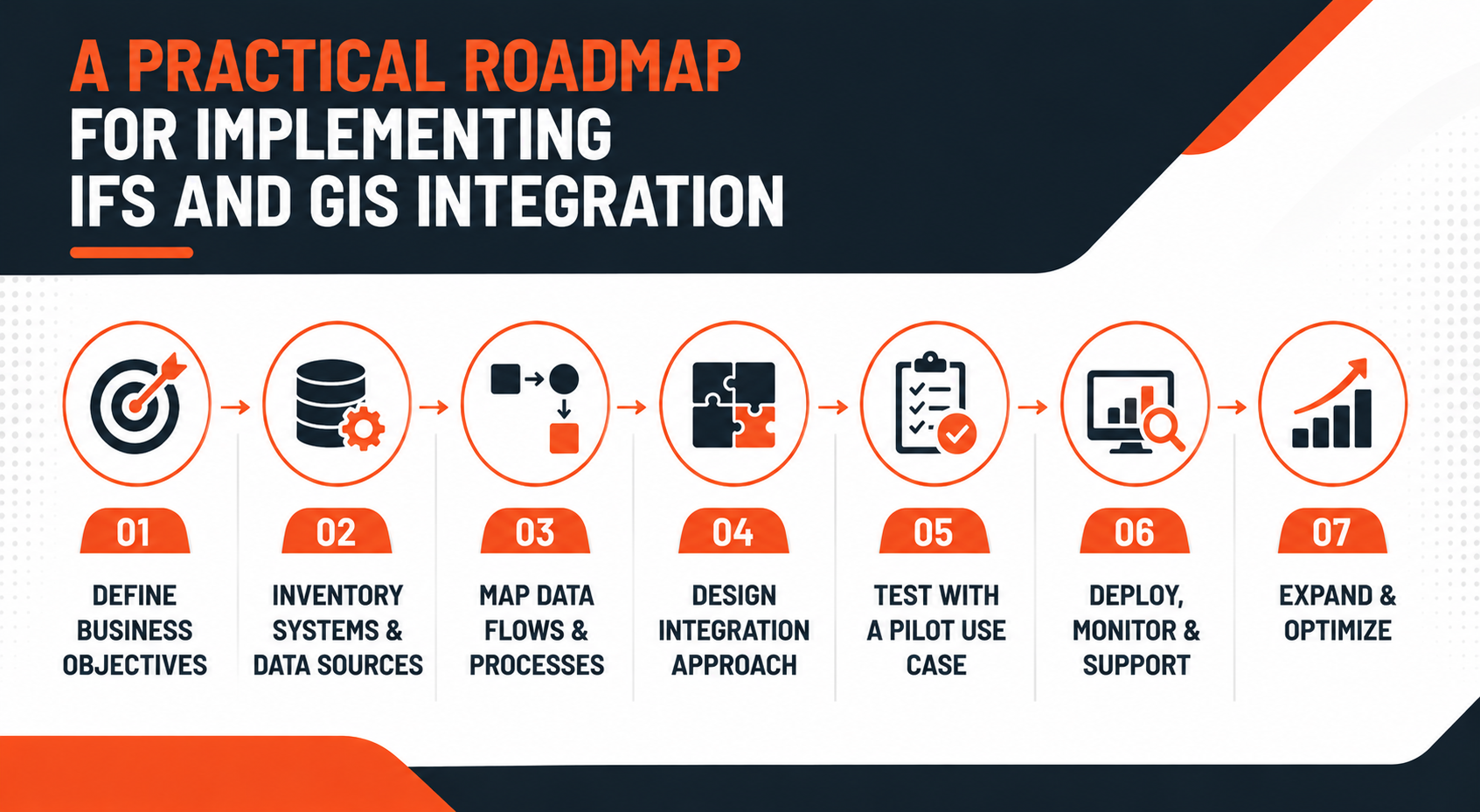
Start with the operational problem, not the integration technology.
For example, the objective may be to improve work order visibility, streamline field inspections, reduce duplicate data entry, strengthen outage response, improve asset data quality, or support regulatory reporting. Clear business objectives help establish priorities and prevent the project from expanding beyond its original scope.
Before designing interfaces, document the systems, data sources, and workflows involved. This often includes IFS Cloud, Esri GIS, OMS, mobile workforce tools, inspection platforms, SCADA systems, reporting platforms, and other operational applications.
The goal is to understand where critical data originates, who owns it, how it moves today, and where manual processes currently create inefficiencies.
Once systems have been identified, map how information moves across the organization. Focus on business workflows rather than technical interfaces alone.
Utilities should understand which system initiates each process, what information needs to be exchanged, how updates are validated, and who is responsible for maintaining data quality. This exercise often uncovers gaps, duplicate processes, and ownership issues before development begins.
Only after business requirements are clearly defined should organizations determine how the integration will be implemented.
The right approach depends on operational requirements, data volumes, performance expectations, security requirements, and long-term support considerations. Whether the solution relies on APIs, middleware, event-driven services, or a hybrid model, the design should prioritize maintainability as much as functionality.
Rather than attempting a large-scale deployment immediately, start with a focused pilot. Common examples include map-based work order visibility, inspection workflows for a specific asset class, or GIS-enabled dispatching within a single service area.
A pilot helps validate data quality, workflow design, user adoption, reporting requirements, and operational readiness before expanding the integration to additional use cases.
Deployment should include monitoring from day one. Integration failures can create operational risk if teams assume data is synchronized when it is not.
Organizations should establish processes for monitoring data synchronization, identifying failed transactions, resolving exceptions, and supporting users after go-live. Long-term success depends as much on operational support as technical implementation.
Once the initial use case is stable, utilities can expand the integration to additional workflows such as vegetation management, outage response, as-built updates, distributed energy resources, mobile inspections, or advanced analytics.
Integration should be viewed as an evolving capability rather than a one-time project. As utility operations mature, new systems, data sources, and business requirements will continue to emerge.
Read Next: IFS ERP Integration Services
IFS and GIS integration helps utilities connect geographic information with operational execution. GIS provides the mapping, network visibility, and spatial context needed to understand utility infrastructure. IFS Cloud provides the enterprise asset management, work management, and field service capabilities needed to maintain and operate that infrastructure.
The most successful integrations start with clear ownership, strong data governance, and focused business objectives. By connecting GIS data with asset management and field operations, utilities can improve visibility, strengthen data integrity, and support more coordinated maintenance, inspection, and outage response workflows.
For organizations evaluating how to connect IFS Cloud with Esri GIS, Astra Canyon helps clients align operational requirements with technology through IFS ERP Integration and industry-focused consulting services. From integration planning and data mapping to workflow design and long-term optimization, Astra Canyon helps utilities build connected environments that support reliable operations and long-term asset management goals.
Ready to connect IFS Cloud and GIS? Contact Astra Canyon to discuss your integration requirements and build a roadmap for improved asset visibility, work management, and field operations.
IFS Cloud can integrate with Esri GIS through APIs, middleware, iPaaS platforms, event-driven architecture, or hybrid integration models. The right approach depends on data volume, real-time requirements, security considerations, and which system owns specific data elements. Successful system integration starts with clearly defined business workflows and data ownership rules.
Utilities often begin with critical assets such as transformers, poles, meters, substations, feeders, valves, and distributed energy resource infrastructure. The integration should focus on assets where geographic information, maintenance history, asset condition, and work management records need to remain aligned.
Yes. IFS work orders can be displayed within a GIS system when work management records are linked to asset locations and spatial data. This allows planners, dispatchers, and field crews to visualize work geographically, group nearby tasks, and improve coordination across field operations.
Common challenges include poor asset data quality, unclear systems of record, mismatched data models, duplicate asset records, weak governance, performance issues, and limited user adoption. Utilities should address these issues before implementation to support seamless integration and long-term maintainability.
It depends on the data element. A geographic information system typically manages spatial data, asset locations, and utility network relationships, while IFS manages maintenance history, asset condition, costs, and operational workflows. Utilities should define ownership at the field level to support stronger information management and data integrity.
The benefits of GIS integration include improved asset visibility, stronger work management processes, better field coordination, reduced duplicate data entry, and more informed decision-making. By connecting operational and geographic information, utilities can create a more complete view of their infrastructure and day-to-day operations.
GIS integration helps organizations connect utility network data with maintenance and operational activities. This allows teams to perform spatial analysis, understand how assets relate to one another, evaluate geographic risk, and make more informed decisions about inspections, maintenance, and outage response.
As utilities modernize, they often need to connect enterprise asset management, GIS, mobile workforce tools, outage management systems, distributed energy resources, analytics platforms, and other management systems. Establishing strong data interoperability and governance practices today can make it easier to support future integration requirements and evolving operational needs.
Astra Canyon helps utilities plan and execute IFS ERP Integration initiatives by defining data flows, mapping fields, supporting data migration activities, designing integration approaches, and aligning workflows across enterprise asset management, field service, and GIS environments. The goal is to create a practical integration strategy that supports long-term operational performance and system management.
 Blake Snider : Aug 21, 2025, 12:45:26 PM
See how integrating IoT with ERP systems boosts real-time data, production visibility, and control in manufacturing.
 Blake Snider : Nov 7, 2025, 7:00:00 AM
Explore how a modern ERP system for smart manufacturing integrates IoT, AI, and automation to drive digital transformation in Industry 4.0.
 Blake Snider : Jun 19, 2026, 3:29:59 PM
Learn how IFS helps upstream oil and gas companies improve field service, workforce scheduling, asset visibility, and maintenance operations.