Asset-heavy industries such as upstream oil and gas depend on field service management and enterprise asset management working together. Yet many organizations still operate with disconnected workflows where field service teams, maintenance planners, supply chain personnel, and ERP users work from different systems and different versions of the same data.
The result is often duplicate data entry, incomplete asset lifecycle records, delayed maintenance decisions, and limited visibility into asset condition. Over time, these gaps can increase operational costs and make it more difficult to manage assets proactively. IFS Cloud can help integrate field service management, ERP, and EAM processes into a connected operational environment that supports asset lifecycle management across upstream operations.
Field service leaders often manage a complex mix of employees, contractors, specialists, and third-party service providers. Workforce planning becomes increasingly difficult when organizations must balance technician certifications, HSE requirements, equipment expertise, geographic proximity, contractor availability, shift schedules, and emergency response priorities.
Many gas companies face workforce shortages while simultaneously operating increasingly complex equipment portfolios. Generic scheduling tools often struggle to account for operational priorities or asset criticality, creating situations where resources are available but not necessarily aligned with the most important work.
IFS FSM supports workforce optimization through scheduling and resource allocation capabilities designed to align technician availability with operational requirements. However, technology alone cannot solve workforce coordination challenges. Organizations should also evaluate workforce readiness, skills management practices, scheduling governance, and contractor oversight. Successful workforce optimization depends as much on operational discipline as it does on software functionality.
Limited visibility is one of the most common challenges across upstream oil and gas field operations. When organizations cannot accurately track work order status, asset condition, crew locations, maintenance history, or service completion activity, decision-making becomes reactive rather than proactive.
This often leads to a cycle of increased downtime, higher operational costs, schedule disruptions, and reactive maintenance practices. The impact extends beyond field service teams. Poor visibility affects maintenance planning, supply chain coordination, asset lifecycle management, regulatory compliance reporting, and executive decision-making.
Many organizations pursuing operational excellence initiatives discover that visibility and automation gaps are limiting their ability to improve efficiency across the broader value chain. For upstream operators, field service visibility is not simply a reporting improvement. It provides the foundation for better maintenance planning, stronger workforce coordination, and more informed asset management decisions.
Field service management software has evolved significantly over the past decade. However, many FSM platforms were originally designed for industries where assets are easier to access, service schedules are more predictable, and operational dependencies are less complex.
Upstream oil and gas environments operate differently. Field activities directly affect production, asset reliability, regulatory compliance, and workforce safety. As a result, organizations should carefully evaluate whether a field service platform can support the realities of upstream operations rather than simply manage work orders and dispatch technicians.
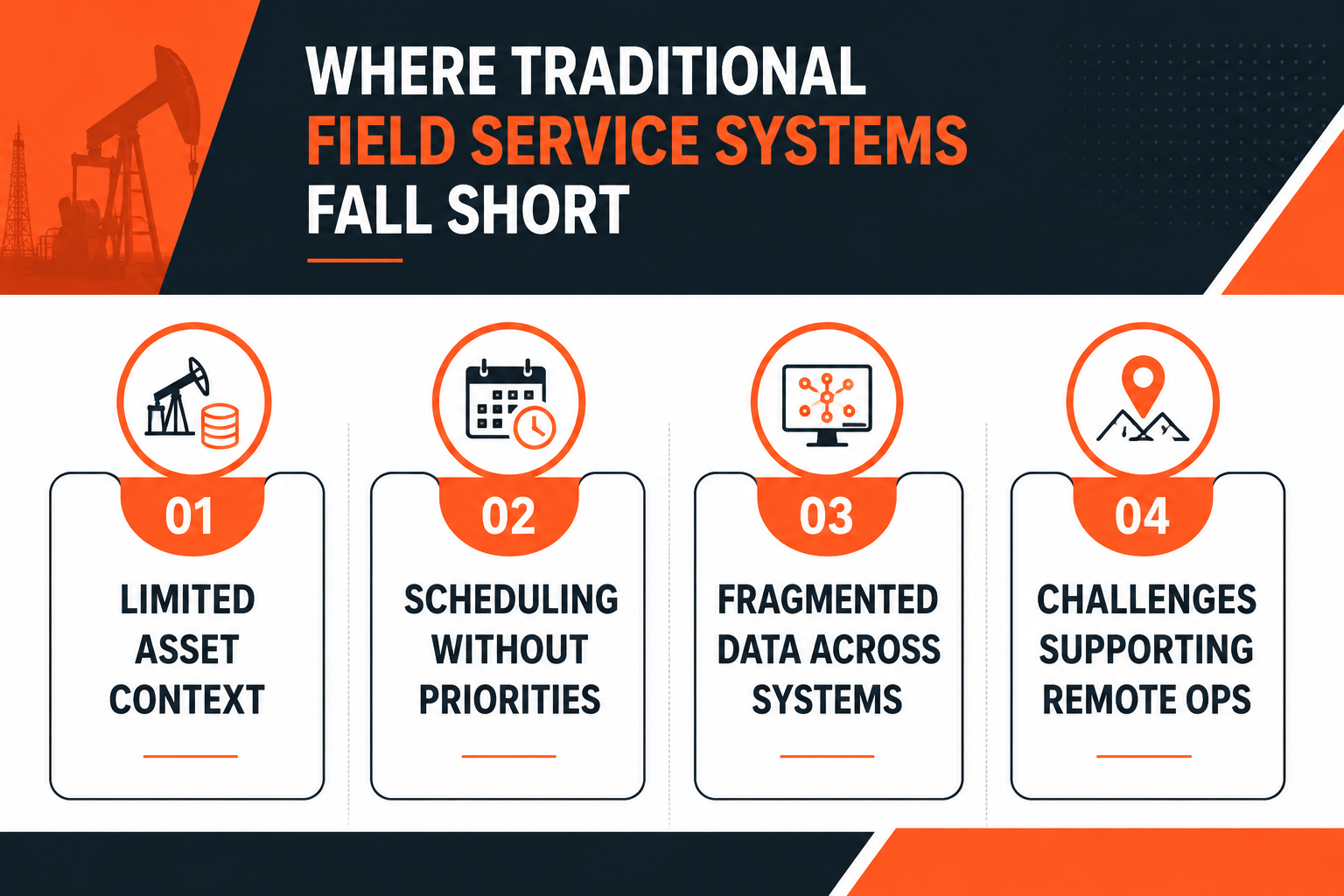
Many field service management platforms focus primarily on dispatching, scheduling, and work order execution. While these capabilities are important, they often provide limited visibility into the broader asset environment.
Field technicians may complete a work order without access to the full maintenance history, reliability data, failure trends, spare parts availability, or asset performance information associated with that equipment. This creates a disconnect between service execution and long-term asset management objectives.
The result is often fragmented decision-making. Field personnel focus on completing individual tasks while maintenance and reliability teams struggle to connect service activity with broader asset lifecycle goals.
IFS Cloud addresses this challenge by combining field service management with enterprise asset management capabilities. This allows service teams, maintenance planners, and operations leaders to work from a more complete view of asset performance across the entire lifecycle.
Not all work orders carry the same business impact.
A production-critical compressor failure may have far greater consequences than a routine maintenance task on supporting equipment. Yet many traditional FSM platforms schedule work primarily based on technician availability, geography, or service-level commitments.
For upstream operators, that approach can overlook important considerations such as production priorities, safety implications, regulatory obligations, operational risk, and asset criticality.
Effective workforce optimization requires more than efficient scheduling. It requires aligning resources with the assets and activities that have the greatest operational impact.
IFS FSM provides greater flexibility for connecting scheduling decisions with operational priorities. However, organizations must still establish clear prioritization frameworks, escalation procedures, and governance processes to ensure technology supports business objectives.
Most upstream operators rely on a collection of systems that have evolved over time. ERP platforms, enterprise asset management systems, SCADA environments, maintenance management applications, GIS platforms, HSE solutions, and contractor management tools often serve different functions across the organization.
The challenge is not that these systems exist. The challenge is that critical operational information often remains isolated within them.
Field crews may update service records in one application while maintenance planners work from another. Asset data may reside separately from production information. Supply chain teams may have limited visibility into upcoming maintenance requirements.
This fragmentation frequently leads to duplicated effort, inconsistent reporting, and delayed decision-making.
Organizations evaluating IFS implementation initiatives should pay close attention to integration requirements. Much of the value of IFS comes from its ability to connect field service management, enterprise asset management, ERP workflows, supply chain processes, and operational reporting within a more unified operating environment.
Read More: What is IFS ERP Software? Everything You Need to Know About IFS Cloud
Challenges Supporting Remote Operations
Remote operations introduce requirements that many traditional field service platforms were not originally designed to support.
Field personnel frequently operate in areas where connectivity is limited or unavailable. Yet they still need access to work orders, inspection procedures, safety documentation, asset records, and service histories while performing critical work.
Without reliable offline capabilities, organizations often rely on spreadsheets, paper forms, manual notes, or delayed data entry. These workarounds may keep operations moving, but they also introduce risk. Asset records become less reliable, reporting becomes less timely, and operational visibility declines.
IFS FSM supports offline workflows that allow technicians to continue working while disconnected and synchronize information once connectivity becomes available. However, offline functionality alone does not guarantee success. Organizations should carefully evaluate field workflows, data standards, and workforce adoption during implementation planning to ensure the technology supports how work is actually performed in the field.
How IFS Supports Upstream Oil & Gas Field Service
Upstream oil and gas organizations require more than basic dispatching software. Field service management must support complex asset environments, remote operations, safety requirements, maintenance planning, and operational decision-making.
IFS Cloud approaches field service management as part of a broader operational ecosystem that connects service execution, enterprise asset management, ERP processes, and analytics. Rather than treating field service as a standalone function, IFS helps organizations align field activities with asset reliability, production objectives, and long-term operational performance.
Intelligent Crew Scheduling and Dispatch
Crew scheduling is one of the most complex operational challenges in upstream field service. Production priorities change quickly, equipment failures occur unexpectedly, and factors such as technician certifications, travel time, asset criticality, and contractor availability all influence scheduling decisions.
Many traditional FSM platforms focus primarily on technician availability and location. Upstream operators typically require a more operationally driven approach that accounts for production priorities, HSE requirements, and asset risk.
IFS FSM supports workforce optimization by helping organizations align scheduling decisions with operational objectives. This can improve resource allocation, increase responsiveness to critical events, and create greater consistency across field operations. However, effective scheduling still depends on clear governance and prioritization processes.
Mobile Workforce Management
Field personnel are often the primary source of operational information across upstream assets. When work is performed in remote environments, delays in reporting can affect maintenance planning, operational visibility, and decision-making.
IFS Cloud supports mobile workforce management through digital work orders, inspections, service records, asset documentation, and HSE reporting. These capabilities allow field teams to capture information closer to the point of work while reducing reliance on paper-based processes.
For upstream operators, mobile functionality becomes especially valuable when combined with offline capabilities that support work in areas with limited connectivity. Organizations should evaluate their field workflows, data collection standards, and workforce readiness to ensure mobility initiatives support operational goals.
Asset-Centric Service Management
Asset reliability is a primary concern across upstream operations. Every field service activity affects the performance, availability, and lifecycle of production assets.
Unlike platforms that focus primarily on task completion, IFS connects service execution with enterprise asset management. This allows organizations to view field activities alongside maintenance history, asset condition, reliability programs, failure analysis, and asset lifecycle information.
The result is greater visibility into how service work affects long-term asset performance. Organizations pursuing predictive maintenance initiatives often find that this asset-centric approach creates a stronger foundation for data-driven maintenance management.
Read Next: A Deep Dive into IFS Cloud for Enterprise Asset Management (EAM)
Real-Time Operational Visibility
Operational visibility is one of the most common reasons organizations invest in IFS. Leaders across operations, maintenance, reliability, and executive management need timely information to make informed decisions.
IFS Cloud supports real-time visibility through connected workflows, integrated reporting, and operational dashboards. Organizations can monitor work order status, workforce utilization, asset condition, maintenance backlog, inspection completion rates, and service performance from a more unified perspective.
Visibility is about more than reporting. It helps organizations improve coordination, respond to issues more quickly, support forecasting efforts, and make more informed operational decisions. For many upstream operators, it also provides the foundation for broader optimization and reliability initiatives.
Practical Upstream Oil & Gas Use Cases for IFS FSM
Field service management delivers value when it supports real operational challenges. Rather than evaluating software features in isolation, upstream operators should assess how a platform supports the day-to-day activities that affect production, asset reliability, safety, and regulatory compliance.
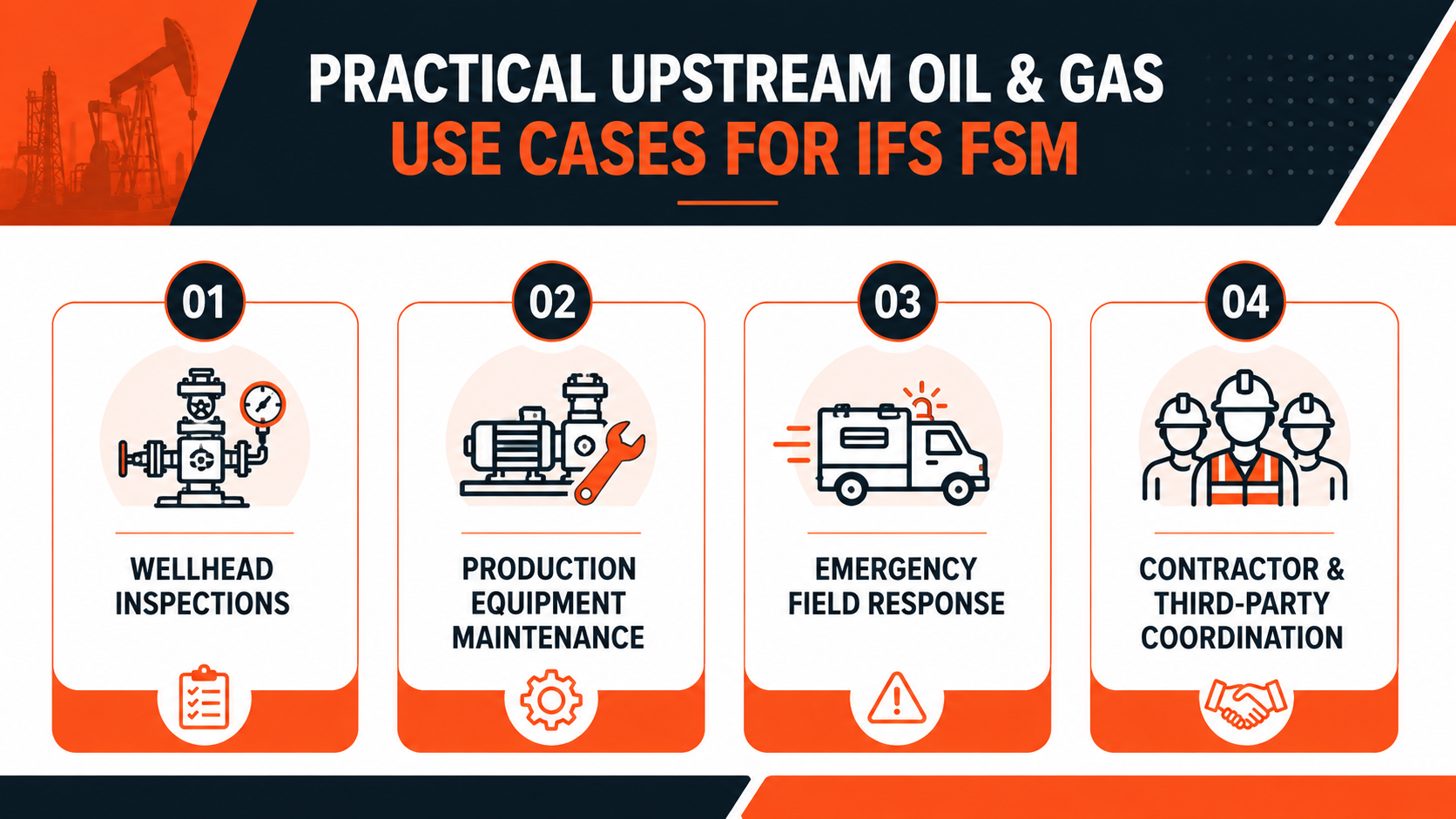
Wellhead Inspection Programs
Routine inspections are critical for maintaining asset integrity across upstream operations. Field personnel are often responsible for collecting equipment readings, documenting asset conditions, identifying leaks, recording HSE observations, and completing regulatory documentation.
When inspection processes rely on paper forms or disconnected systems, reporting delays and incomplete records can make it more difficult to identify emerging issues. IFS FSM can help standardize inspection workflows while improving visibility into inspection completion, findings, and follow-up actions.
Organizations should evaluate how inspection activities connect with maintenance management, enterprise asset management, and compliance reporting processes. The greatest value often comes from ensuring inspection data can be acted upon rather than simply recorded.
Production Equipment Maintenance
Production assets require ongoing maintenance throughout their lifecycle. Whether managing artificial lift systems, compressors, pumps, separators, pipeline equipment, or produced water infrastructure, maintenance teams need timely information to keep assets operating reliably.
IFS supports maintenance workflows by connecting service execution with asset management, planning, and operational reporting. This allows organizations to better coordinate field activities, maintenance schedules, and asset performance information within a single operating environment.
For many upstream operators, the objective is not simply to complete maintenance work. It is identifying maintenance requirements early enough to reduce downtime and minimize production disruption.
Emergency Field Service Response
Unexpected equipment failures remain a reality across upstream operations. When critical assets fail, response time can directly affect production continuity, operational risk, and workforce safety.
IFS FSM supports emergency response activities through dynamic scheduling, workforce visibility, resource allocation, mobile communications, and service status tracking. These capabilities can help organizations identify available resources more quickly and coordinate response efforts across multiple locations.
Technology alone does not determine emergency response effectiveness. Organizations should also evaluate how response procedures, escalation processes, and business continuity plans align with broader asset reliability and operational risk management strategies.
Contractor and Third-Party Workforce Coordination
Many upstream operators rely on contractors to supplement internal field service teams. While this approach provides flexibility, it can also introduce challenges related to scheduling, compliance, documentation, visibility, and service quality.
IFS can help create greater consistency across internal and external service operations by providing a more structured framework for work assignment, status tracking, documentation, and reporting. This may improve visibility into contractor performance while helping ensure work is completed according to operational and regulatory requirements.
However, technology should not replace governance. Organizations should establish clear contractor management processes, reporting expectations, and performance metrics before relying on software to improve coordination.
Connecting Field Operations to Enterprise Asset Management
Field service management delivers greater value when it operates as part of a broader operational strategy rather than as an isolated function. For many upstream oil and gas organizations, field activities directly influence asset reliability, production performance, maintenance planning, and long-term investment decisions.
This is where the connection between field service management and enterprise asset management becomes critical. When service execution, maintenance planning, and asset data operate within separate systems, organizations often struggle to maintain a complete view of asset performance. Connecting these functions helps create a more accurate operational picture while supporting better maintenance and reliability decisions.
Integrating FSM and EAM
Many oil and gas companies manage field service and maintenance planning through separate processes and systems. Field personnel complete work orders while maintenance planners oversee preventive maintenance programs, reliability initiatives, and asset lifecycle planning elsewhere.
Over time, this separation can create duplicate records, delayed updates, incomplete asset histories, and reduced confidence in asset data.
IFS Cloud supports the integration of field service management and enterprise asset management within a connected operating environment. By linking work orders, service records, maintenance plans, inspection results, and asset lifecycle information, organizations gain greater visibility into how field activities affect long-term asset performance.
The objective is not integration for its own sake. The objective is to create a reliable foundation for maintenance planning, reliability improvement, and more informed operational decision-making.
Improving Reliability and Uptime
Reducing downtime remains a primary objective across upstream operations. Production interruptions affect far more than maintenance teams. They can influence production targets, workforce utilization, regulatory compliance, supply chain planning, and overall business performance.
IFS Cloud supports reliability-focused workflows by connecting field service activities with broader maintenance management programs. This creates greater visibility into asset condition, maintenance history, inspection findings, and reliability trends.
Organizations pursuing preventive or predictive maintenance initiatives often discover that reliable asset data is just as important as the technology itself. Asset records, inspection results, and work order histories must remain accurate and consistent if organizations expect to make data-driven maintenance decisions.
Read Next: The Benefits of AI in ERP Systems: A Deep Dive into IFS Applications (2026 Guide)
https://www.astracanyon.com/blog/the-benefits-of-ai-in-erp-systems-a-deep-dive-into-ifs-applications
Inventory and Parts Visibility
Maintenance delays frequently occur because the required materials are not available when field crews arrive on site. In remote upstream environments, where supply chain lead times can be significant, these delays can quickly affect production schedules and operational costs.
IFS Cloud helps connect field service management with inventory and procurement processes, providing greater visibility into spare parts availability, material reservations, procurement activity, and supply chain constraints. This allows maintenance planners and field teams to make more informed decisions before work begins.
Organizations should evaluate how effectively their current systems connect maintenance planning, field service execution, and inventory management. In many cases, improving coordination between these functions can be just as valuable as improving the maintenance process itself.
Operational Reporting and Analytics
Data-driven decision-making depends on access to accurate and timely operational information. However, many organizations struggle because critical data is spread across multiple systems and departments.
IFS Cloud supports reporting and analytics capabilities that bring together information from field service, asset management, maintenance, and operational processes. This can help organizations monitor asset performance, workforce utilization, maintenance backlog, inspection compliance, and downtime trends from a more unified perspective.
The goal is not simply to collect more data. It is enabling operational leaders to identify trends, forecast future requirements, and make better-informed decisions. Organizations should evaluate reporting requirements early in an IFS implementation initiative, as reporting challenges often originate from process design and data quality rather than technology limitations.
Evaluating IFS for Upstream Field Service Operations
Organizations considering IFS FSM should evaluate the platform through an operational lens rather than focusing exclusively on software functionality. The most successful initiatives align technology capabilities with business processes, workforce requirements, asset management objectives, and long-term operational goals.
Before evaluating features, organizations should first assess whether their current field service environment supports the level of visibility, coordination, and reliability required across upstream operations.
Questions Operations Leaders Should Ask
Before committing to a field service management initiative, organizations should evaluate their current operating environment and identify the challenges they are trying to solve.
Questions worth asking include:
-
Are field operations standardized across locations?
-
Is asset data accurate, complete, and maintained consistently?
-
How much downtime is driven by reactive maintenance?
-
Are contractor workflows managed consistently?
-
Can leaders access timely operational information?
-
Do existing systems support enterprise asset management objectives?
-
Are compliance requirements clearly documented and enforced?
The answers often reveal whether process improvement, data cleanup, or workflow standardization should occur before technology implementation begins.
Key Capabilities to Prioritize
Not every capability carries equal importance. Organizations should prioritize features that directly support their operational requirements rather than evaluating platforms based on the number of available functions.
The relative importance of these capabilities will vary based on asset profiles, operating environments, workforce structures, and organizational maturity.
Readiness Considerations
Technology projects frequently encounter challenges when organizational readiness is overlooked. Before implementing IFS, organizations should evaluate the quality of their data, the consistency of their processes, and the complexity of their operating environment.
Data Quality
Asset records should be reviewed before migration. Incomplete or inconsistent asset data can undermine maintenance planning, reporting, predictive maintenance initiatives, and long-term asset management efforts.
Process Standardization
Organizations operating across multiple regions often develop different field service procedures over time. Standardizing workflows where appropriate can improve consistency, reporting accuracy, and implementation outcomes.
Integration Requirements
Most upstream operators maintain existing systems for production management, SCADA, HSE, supply chain operations, and regulatory reporting. Organizations should carefully assess how IFS will interact with these environments and where integration dependencies exist.
Read More: IFS Integration Project Best Practices: What to Know Before You Start
Change Management
Workforce adoption remains one of the most important success factors in any field service initiative. Field personnel, maintenance teams, planners, and operational leaders should understand not only how new workflows function, but also why those changes support broader business objectives.
Successful implementations are rarely driven by technology alone. They depend on process alignment, workforce engagement, data quality, and a clear understanding of the operational outcomes the organization is trying to achieve.
Is Your Upstream Field Service Operation Ready for IFS?
Implementing IFS should begin with operational readiness rather than software selection. Organizations often achieve stronger outcomes when they first evaluate their processes, data quality, workforce practices, and technology environment before committing to a field service transformation initiative.
Signs Current Processes Are Holding You Back
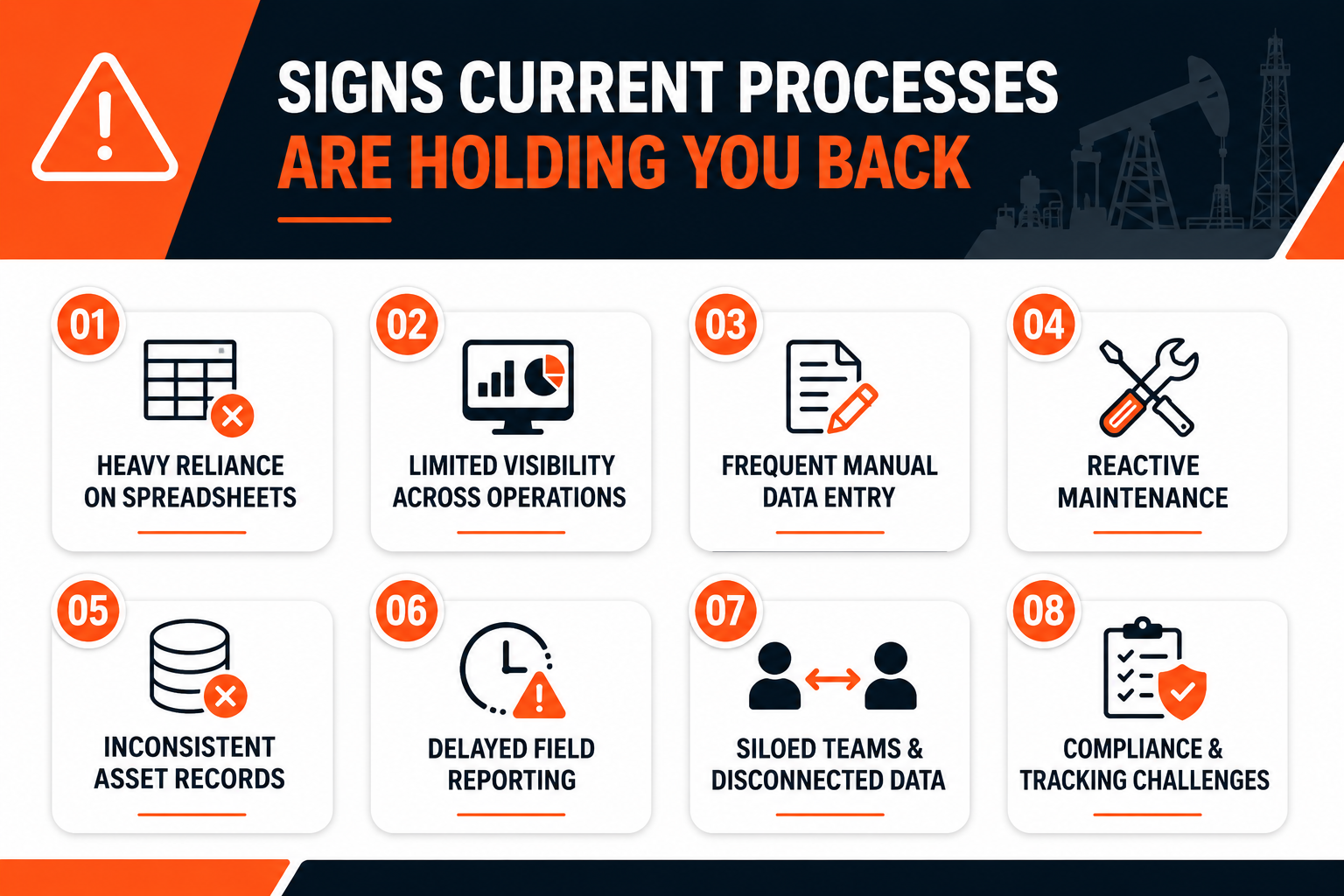
Many organizations recognize the need for change when operational inefficiencies become increasingly difficult to ignore. Common indicators include heavy reliance on spreadsheets, limited visibility across field operations, frequent manual data entry, reactive maintenance practices, inconsistent asset records, and delayed field reporting.
In some cases, service teams and maintenance planners operate from different sources of information, making coordination more difficult and reducing confidence in operational reporting. Difficulty meeting compliance requirements or tracking field activity consistently may also signal that existing processes are no longer supporting business objectives.
These challenges do not necessarily indicate a technology problem. More often, they reveal workflow, data, or process issues that should be addressed before implementation begins.
Building a Practical Roadmap
Organizations should approach implementing IFS as a business transformation initiative rather than a software deployment. The most successful projects begin with a clear understanding of current operations and a realistic view of future requirements.
A practical roadmap typically starts with a current-state assessment focused on workflows, asset management practices, workforce structures, technology environments, and data quality. From there, organizations can identify opportunities to improve process consistency, strengthen field operations, enhance visibility, and support asset lifecycle management.
Technology evaluation should occur within this broader context. Rather than comparing feature lists, organizations should assess how IFS Cloud supports their operational priorities, field service requirements, enterprise asset management objectives, and long-term business goals.
Implementation Considerations
Successful IFS implementation projects require more than technical configuration. Workforce adoption, integration planning, and long-term scalability all play important roles in achieving lasting value.
Field personnel, maintenance teams, planners, and operational leaders should understand how new workflows support broader business objectives. Organizations should also define how IFS will interact with existing systems and identify integration requirements early in the planning process.
Finally, leaders should consider future growth. Many upstream operators eventually expand digital transformation initiatives into adjacent areas such as enterprise asset management, supply chain operations, predictive maintenance, operational analytics, and other energy sector business functions. Planning for scalability from the beginning can help reduce future complexity while supporting long-term operational improvement.
Building a More Connected Field Service Operation
Upstream oil and gas field service is not just a scheduling challenge. It requires visibility across assets, maintenance activities, contractors, inventory, and field execution to support reliable operations in complex and often remote environments.
IFS Cloud helps connect these activities within a single platform, bringing together field service management, enterprise asset management, ERP, workforce planning, mobile execution, and operational reporting. This connected approach can help operators improve coordination, reduce reactive work, and make more informed decisions across field operations.
For organizations evaluating how to improve field service planning and execution, Astra Canyon helps clients align IFS Cloud with operational requirements through IFS ERP Implementation, IFS ERP Integration, and ongoing Application Managed Services. From workflow design and system integration to long-term optimization and support, Astra Canyon helps organizations build a connected field service environment that supports operational visibility, asset reliability, and execution consistency across the asset lifecycle.
Whether you're evaluating field service transformation, improving maintenance execution, or planning an IFS Cloud deployment, Astra Canyon can help you align IFS with your field operations, asset management, and reliability objectives.
Frequently Asked Questions
How does IFS support upstream oil and gas field operations?
IFS supports upstream oil and gas field operations through field service management, enterprise asset management, workforce optimization, service automation, and mobile workforce capabilities. By connecting field activities with asset management and ERP processes, IFS Cloud helps organizations improve visibility across remote assets and gas operations.
What makes upstream oil and gas field service different from traditional FSM software?
Upstream field service typically involves remote locations, production-critical assets, HSE requirements, and complex compliance requirements. Many traditional FSM software platforms focus primarily on dispatching and work order management, while upstream operators often require deeper integration with asset management, maintenance planning, and operational reporting.
Can IFS Cloud support predictive maintenance initiatives?
Yes. IFS Cloud can support predictive maintenance programs by connecting field service data, maintenance history, inspection results, and asset performance information. However, organizations should recognize that predictive maintenance depends on reliable asset data, consistent processes, and effective governance in addition to technology.
How does IFS integrate field service management and enterprise asset management?
IFS integrates field service management and enterprise asset management within a connected platform. This allows organizations to link work orders, inspections, maintenance records, reliability information, and asset lifecycle data, helping teams make more informed maintenance and investment decisions while integrating asset management across operations.
Can IFS help improve operational efficiency in remote field environments?
IFS supports operational efficiency through mobile field service capabilities, workforce optimization, service automation, and real-time visibility. These capabilities can help organizations streamline operations, improve coordination between field teams and headquarters, and reduce delays associated with manual processes.
What should oil and gas companies evaluate before implementing IFS solutions?
Before implementing IFS solutions, organizations should assess asset data quality, workflow maturity, workforce readiness, integration requirements, reporting needs, and long-term operational objectives. Many IFS implementation challenges originate from process and data issues rather than technology limitations.
Can IFS support contractor and third-party workforce management?
Yes. IFS can support contractor scheduling, service tracking, documentation, compliance oversight, and workforce coordination. Organizations utilizing IFS should establish clear governance structures and performance expectations to ensure consistent service delivery across internal and external teams.
Is IFS only used in upstream oil and gas?
No. While this article focuses on upstream oil and gas operations, IFS Cloud is also used across midstream and downstream operations, energy and utilities, manufacturing, mining, aerospace and defense, and renewable energy environments. Its integrated platform approach is particularly valuable for asset-intensive organizations that require strong asset management and field service capabilities.
 Blake Snider

 Blake Snider : Jun 9, 2026, 10:00:00 AM