The mining industry faces rising pressure to improve productivity, reduce downtime, manage workforce shortage, and respond faster to supply chain disruption. Mining companies also need to meet changing regulatory requirements, ESG expectations, and safety and environmental obligations while managing complex operations across sites.
IFS Cloud helps operators modernize mining operations by connecting enterprise resource planning, enterprise asset management, EAM, procurement, supply chain management, workflow automation, analytics, and real-time data in a single platform. Instead of relying on disconnected systems or spreadsheet-based processes, teams can improve collaboration, make informed decisions, and strengthen planning and execution across the full operational lifecycle.
Industrial AI and IFS.ai add another layer of optimization. By using predictive maintenance, automation, forecasting, IoT data, and AI-driven analytics, mining companies can improve asset reliability, reduce risk, automate operational processes, and unlock long-term value from AI adoption.
This article explores practical AI use cases, real-world benefits, and a framework for operations with IFS Cloud that supports operational efficiency, adaptability, and competitive advantage.
TL;DR: How IFS Fixes Remote Mining Logistics Gaps
-
Connect pit, plant, and port on one platform: IFS Cloud provides real-time logistics operations performance visibility across all remote sites and transport legs.
-
Replace spreadsheet logistics planning: Automated workflows in IFS Cloud handle allocation, scheduling, and execution monitoring without manual intervention or data quality issues.
-
Use industrial AI and predictive analytics: ifs.ai reduces unplanned downtime and extends asset reliability by analyzing volumes of data from equipment and operational processes.
-
Integrate procurement, inventory, and transport management: Mining companies respond faster to disruption or shortage events with unified supply chain management across sites.
-
Leverage IoT data for informed decisions: Real-time data from sensors and telematics helps operators make informed decisions that enhance productivity and operational efficiency.
-
Align logistics with ESG and regulatory requirements: IFS enables tracking of emissions, safety incidents, and compliance documentation to support changing regulatory requirements and ESG reporting.
-
Build long-term value through digital transformation: A single platform approach supports adaptability, competitive advantage, and an environment that supports continuous improvement in mining operations.
Why Remote Site Logistics Breaks in the Mining Industry
The mining industry faces complex logistics operations challenges across remote sites, harsh environments, changing regulatory requirements, and ESG expectations. Many mining companies still rely on disconnected systems, spreadsheet workflows, and legacy ERP systems that limit real-time visibility, data quality, and the ability to respond faster to disruption.
Understanding where these systems break down is the first step toward implementing IFS as a modern, integrated platform for mining operations, supply chain management, procurement, asset reliability, and operational efficiency.
Disconnected Systems from Pit to Port
Most mining operations span multiple sites, transport modes, and handoff points, from extraction at the pit through processing plants to rail or port export facilities. When these stages operate on separate systems, such as spreadsheets for scheduling, standalone inventory tools, manual maintenance logs, and email-based coordination, workflows become fragmented across the full logistics chain.
Teams lose a single source of truth for allocation decisions, stockpile levels, equipment availability, procurement status, and transport schedules. That weakens planning and execution because operators are forced to make informed decisions using outdated or incomplete information.
The absence of enterprise resource planning integration also keeps procurement, maintenance, workforce, and transport teams in silos. Upstream delays may not be visible to downstream teams in time, creating constant firefighting and manual reconciliation.
These gaps make optimization harder. Disconnected systems prevent mining companies from using automation, analytics, or Industrial AI across operational processes, leaving valuable insight locked inside volumes of data that are never consolidated or analyzed.
Limited Real-Time Data in Harsh, Remote Environments
Remote mining operations create unique challenges for data collection and visibility, especially when sites operate with weak connectivity, extreme weather, limited infrastructure, or equipment spread across large distances.
-
Difficulty getting real-time data from remote mining operations: Connectivity gaps mean data from haul trucks, conveyors, crushers, and port equipment may arrive late, preventing decision-maker teams from seeing current conditions.
-
Data latency prevents rapid response to disruption: When weather events, equipment failures, safety incidents, or logistics disruptions occur, limited real-time alerts make it harder for teams to respond faster, reduce risk, and minimize downtime.
-
Volumes of data are collected but not turned into analytics: IoT devices, telematics systems, and sensors generate large amounts of operational data, but without an integrated platform, mining companies face data-rich but insight-poor environments.
-
Manual data entry introduces errors and delays: Spreadsheet-based workflows require operators to manually input readings, shipment details, maintenance logs, and procurement updates, creating data quality issues that cascade through planning and execution.
The result is limited real-time visibility across logistics operations. Teams must rely on assumptions, historical patterns, and reactive decisions instead of data-driven optimization, predictive maintenance, and proactive workflow automation.
Safety, ESG, and Regulatory Complexity
Mining companies face growing pressure to meet safety and environmental standards, demonstrate ESG performance, and comply with changing regulatory requirements across jurisdictions. Unplanned downtime, poor asset reliability, and manual reporting make compliance harder to manage and prove.
When maintenance records, safety incidents, emissions data, transport logs, and workforce records sit across disconnected systems, audit-ready reporting becomes time-consuming and error-prone. ESG reporting can also extend to supply chain emissions, energy use in logistics operations, and workforce safety metrics, which increases the need for stronger data quality and cross-site visibility.
This is where predictive maintenance, asset reliability tracking, analytics, and automation become important. Better operational data helps organizations reduce risk, improve safety and environmental performance, and identify issues before they become major disruptions.
Without an integrated platform, mining companies face higher exposure to regulatory scrutiny, operational disruption, insurance pressure, and reputational damage. IFS Cloud can help operators modernize these workflows by connecting EAM, enterprise resource planning, procurement, supply chain management, and real-time data in one platform that supports long-term value and more resilient operations.
Read Next: What is IFS ERP Software? Everything You Need to Know About IFS Cloud
6 Practical Ways IFS Improves Mining Logistics
Pit-to-port logistics depends on fast coordination between production, maintenance, supply chain, procurement, workforce, and port teams. IFS Cloud and IFS.ai give mining companies an integrated platform for planning and execution, enterprise asset management, predictive analytics, and workflow automation so operations with IFS Cloud can reduce unplanned downtime, improve collaboration across sites, and unlock long-term value.
IFS positions IFS Cloud for mining as combining ERP, EAM, and field service management capabilities, with Industrial AI supporting predictive maintenance, asset intelligence, and workflow automation.
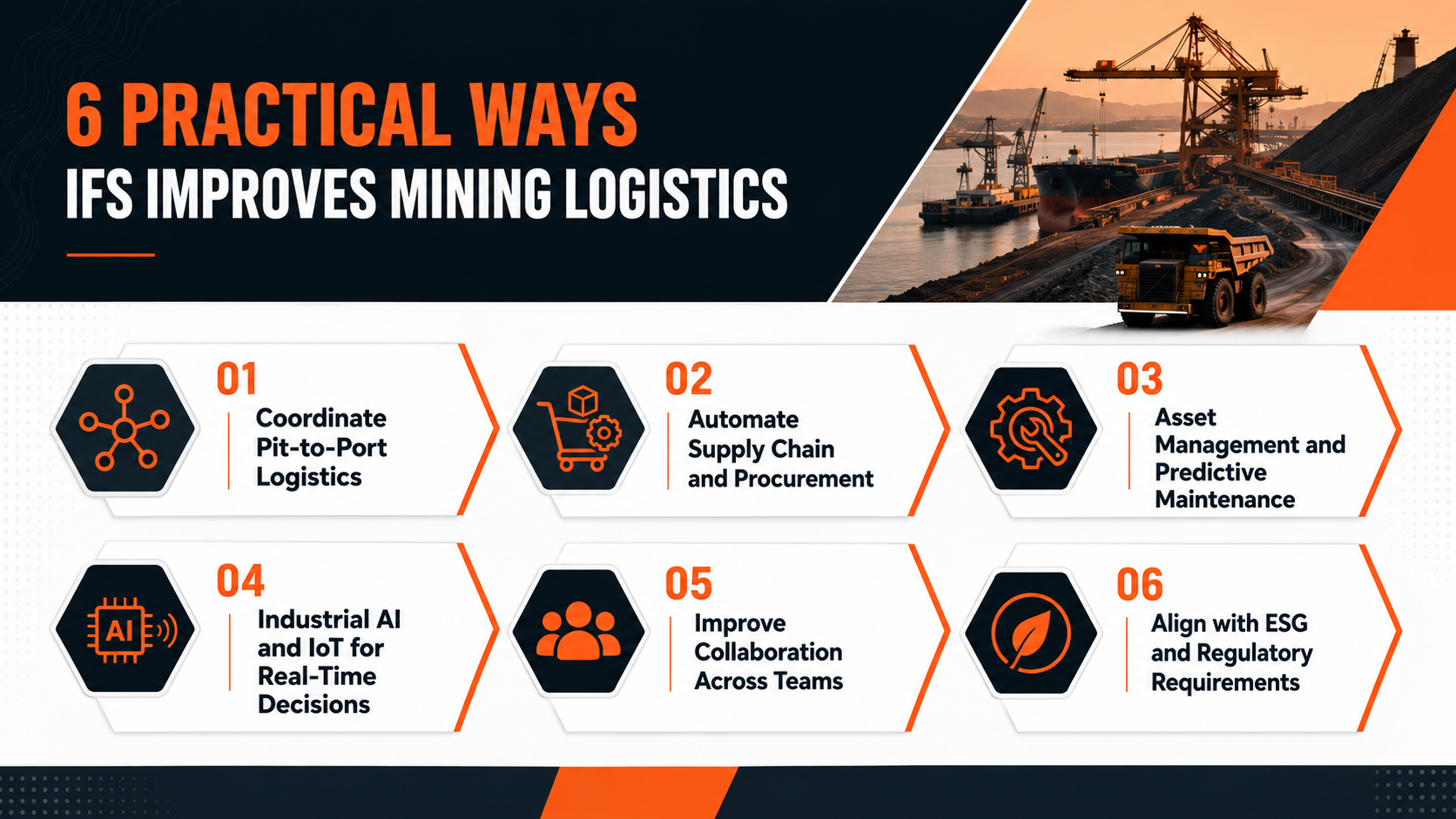
#1) Coordinating Pit-to-Port Logistics on One Platform
IFS Cloud, ERP solutions, and EAM capabilities provide one platform for planning, scheduling, and monitoring pit, plant, and port activities. Instead of coordinating through disconnected systems, spreadsheets, and phone calls, mining companies can connect material movement, equipment availability, workforce allocation, procurement status, and logistics operations in a shared operating environment.
That visibility helps operators track material flow from extraction through crushing, stockpiling, rail or truck transport, and port loading. Planners can identify bottlenecks in real time, adjust allocation based on equipment availability or weather conditions, and optimize throughput without relying on manual workarounds.
Workflow automation in IFS can support load scheduling, stockpile management, transport coordination, and port planning by keeping teams aligned around current operational data. When a haul truck breaks down, rail shipment is delayed, or port timing changes, teams can assess downstream impacts faster and adjust routing, timing, or resource allocation before disruption spreads.
This level of integration supports supply chain management that responds to real-world conditions rather than static plans. Operations with IFS Cloud also improve collaboration between pit supervisors, plant operators, and port logistics teams, helping organizations enhance productivity, improve planning and execution, and build competitive advantage across the full pit-to-port chain.
#2) Automating Remote Site Supply Chain and Procurement
Remote mining operations depend on the timely delivery of fuel, spare parts, consumables, and equipment to avoid costly downtime. Traditional procurement processes often rely on manual requisitions, email approvals, and spreadsheet tracking, which can slow fulfillment and create data quality issues.
-
Automate procurement and materials replenishment: IFS Cloud can support purchase order generation, supplier coordination, and inventory replenishment based on defined thresholds, consumption patterns, and operational requirements.
-
Use forecast and predictive demand signals: Historical usage, maintenance schedules, and operational plans can help procurement teams forecast future needs and place orders proactively instead of reacting to shortage events.
-
Integrate supplier data and contracts: IFS provides a centralized environment for supplier performance, contract terms, lead times, and delivery information, helping mining companies respond faster when primary suppliers face disruption.
-
Enable mobile access for remote site managers: Field teams can submit requisitions, approve orders, and track shipment status from mobile devices, helping reduce lag between need identification and fulfillment.
By automating supply chain processes and improving data quality, IFS helps organizations reduce the risk of unplanned downtime caused by parts shortages. It also improves procurement efficiency and frees workforce capacity for higher-value operational processes.
#3) Enterprise Asset Management and Predictive Maintenance Across Sites
Enterprise asset management in IFS Cloud supports predictive maintenance, asset reliability, and maintenance workflows for mining companies operating mobile fleets, crushers, conveyors, and port equipment across remote locations. IFS Cloud EAM is designed for asset-intensive organizations and supports lifecycle control, asset performance management, and Industrial AI-enabled maintenance planning.
IFS.ai and Industrial AI can use volumes of data from sensors, IoT devices, telematics, and maintenance logs to identify patterns that may indicate equipment degradation. This helps maintenance teams move from reactive repairs toward condition-based and predictive maintenance strategies that reduce unplanned downtime and extend asset life.
IFS also tracks asset performance across sites, giving decision-makers visibility into utilization rates, maintenance costs, reliability trends, and operational risk. That insight supports capital planning, replacement decisions, and maintenance prioritization for assets with the greatest impact on production, safety, and logistics operations.
The integration of EAM with supply chain management is especially valuable in remote mining operations. When a predictive alert triggers a maintenance event, teams can check parts availability, allocate resources, schedule technicians, and coordinate work to minimize disruption across logistics operations.
#4) Using Industrial AI and IoT for Real-Time Operational Decisions
Mining companies can leverage IoT sensor data, analytics, and IFS.ai to identify bottlenecks, optimize resource allocation, and make informed decisions that improve operational efficiency. IFS describes Industrial AI as supporting predictive maintenance, asset intelligence, workflow automation, and operational data outcomes for heavy industry.
-
Identify bottlenecks in logistics operations: Real-time data from haul trucks, conveyors, loading equipment, and port assets can show where delays occur, helping operators adjust workflows, reassign equipment, or modify schedules.
-
Use real-time alerts and predictive insights: IFS.ai can help flag abnormal operating patterns, such as vibration changes, fuel consumption spikes, or equipment performance deviations, so teams can respond faster to disruption.
-
Apply AI use cases for routing and allocation: Industrial AI can support analysis of traffic patterns, road conditions, equipment availability, and port schedules to improve routing, timing, and allocation decisions.
-
Support workforce deployment decisions: Analytics on crew productivity, equipment utilization, and task completion can help decision-maker teams deploy the workforce more effectively across shifts and sites.
The power of industrial AI is its ability to process volumes of data that manual analysis cannot handle at scale. This AI-driven approach supports digital transformation by embedding optimization, forecasting, and predictive capabilities into daily operational processes.
#5) Improving Collaboration Between Sites, Planning, and Port Teams
Integrated operational systems improve collaboration across sites, central planning, and port teams by providing a shared view of operational data. When pit supervisors, plant managers, supply chain teams, and port logistics coordinators work from the same information, they can better understand how upstream decisions impact downstream performance.
Workflows in IFS can automate handoffs and notifications, reducing the need for manual communication, email chains, and phone calls. For example, when a shipment leaves the mine site, port teams can receive updated information on expected arrival timing, tonnage, and handling requirements.
Analytics dashboards can show performance across sites, including cycle times, throughput rates, asset utilization, and on-time delivery. These insights help organizations improve operational efficiency, identify areas for optimization, and strengthen planning and execution.
This capability is valuable when mining companies face disruption from weather events, equipment failures, workforce constraints, or regulatory changes. By improving collaboration and creating a stronger single source of truth, IFS helps organizations move from reactive firefighting to proactive optimization.
#6) Aligning Logistics Operations with ESG and Regulatory Requirements
Mining companies face growing pressure to demonstrate ESG performance and comply with changing regulatory requirements related to emissions, safety, and environmental impact. IFS can support this by connecting operational data, maintenance records, safety workflows, procurement activity, and logistics performance in one integrated platform.
-
Track energy, emissions, and safety incidents: IFS can help capture data on fuel consumption, greenhouse gas emissions, water use, safety incidents, and logistics activity to support ESG reporting and operational improvement.
-
Document adherence to regulatory requirements: The system can maintain audit trails for transport permits, hazardous materials handling, safety inspections, and environmental monitoring, helping mining companies prepare for regulatory audits.
-
Support sustainability initiatives: Analytics in IFS can help organizations identify inefficiencies such as excessive idling, suboptimal routing, underused assets, or avoidable transport delays that increase cost and environmental impact.
-
Integrate safety and environmental data with operational processes: By embedding safety and environmental tracking into workflow planning and execution, compliance becomes part of daily operations rather than a separate reporting exercise.
Aligning logistics operations with ESG and regulatory requirements helps reduce risk, protect reputation, and build long-term value. A connected platform also helps mining companies adapt to changing regulatory requirements without rebuilding operational processes from scratch.
Read Next:
Are Your Remote Logistics Ready for IFS Cloud? A Practical Diagnostic
Moving from spreadsheet workarounds and legacy ERP systems to IFS Cloud requires more than software selection. Mining companies need reliable data, clear workflows, workforce readiness, and a practical framework for connecting remote site logistics across the full pit-to-port chain.
The goal is to understand whether your current operational processes are ready for a modern, integrated platform or whether foundational work is needed before implementing IFS.
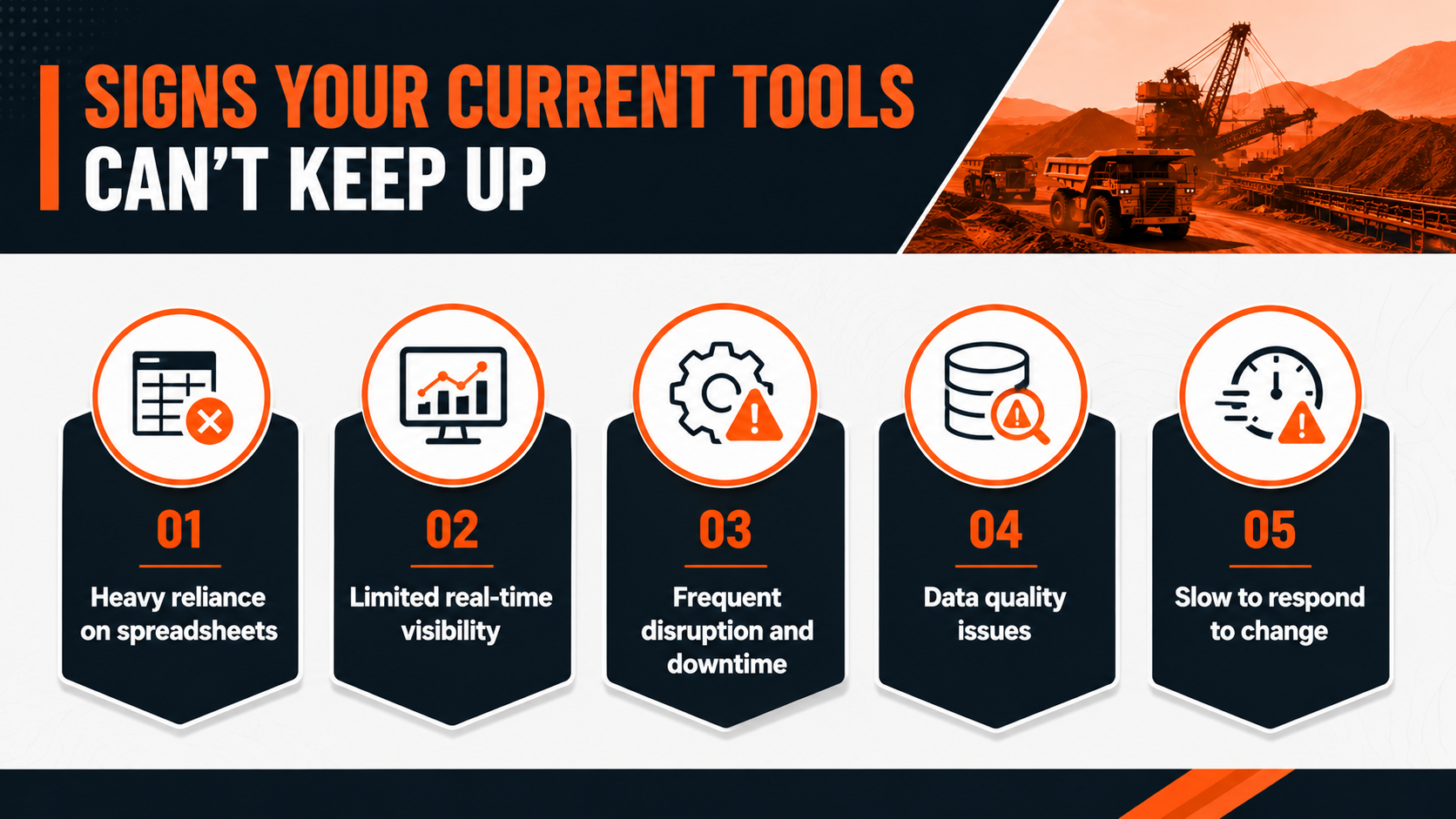
Signs Your Current Tools Can't Keep Up
Recognizing the symptoms of system strain is the first step toward making the case for IFS, industrial AI, and digital transformation in remote mining operations.
-
Heavy reliance on spreadsheet workarounds: If teams spend significant time maintaining spreadsheets for shipments, inventory, procurement, and maintenance windows, your core systems may lack the workflow automation and integration needed for efficient logistics operations.
-
Limited real-time visibility into logistics KPIs: When decision-makers cannot quickly access current data on throughput, cycle times, equipment availability, stockpile levels, or performance across sites, planning and execution suffer.
-
Frequent disruption and unexpected downtime: If equipment failures, parts shortages, or coordination breakdowns regularly disrupt logistics operations, it may indicate weak predictive capabilities, inadequate supply chain management, and disconnected systems.
-
Data quality issues and manual reconciliation: When teams spend hours reconciling conflicting data from different tools, it reflects the absence of a single platform and integrated enterprise resource planning architecture.
-
Inability to respond faster to changing conditions: If your organization struggles to adjust plans when weather, equipment, workforce, or market conditions change, your systems may lack the real-time data and analytics needed for agile decision-making.
These signs can hold back productivity, operational efficiency, and the ability to leverage automation, AI use cases, and industrial AI for competitive advantage.
Data, People, and Process Requirements for Implementing IFS
Successful IFS implementations require strong foundations across data, workforce, and workflow design. Mining companies should assess the completeness and consistency of master data for assets, suppliers, inventory, procurement, and operational processes before migration because IFS Cloud relies on accurate data to support automation, analytics, predictive maintenance, and informed decisions.
Teams also need clear roles, responsibilities, and decision rights, especially where operations with IFS Cloud will change planning and execution across sites. Workforce training and change management help operators, planners, maintenance teams, and supply chain teams trust the system, use real-time data effectively, and understand where IFS.ai or industrial AI recommendations fit into daily decisions.
Workflow clarity matters just as much. Mining companies should document current processes, identify inefficiencies, and design future-state workflows that use IFS capabilities such as enterprise asset management (EAM), supply chain management, procurement automation, real-time visibility, and integrated platform support. Requirements for regulatory compliance, ESG reporting, and safety and environmental tracking should also be defined early, so the platform captures the right data from the start.
Engaging stakeholders early, from pit supervisors to port managers, improves collaboration and ensures the system reflects real-world operating needs. That alignment helps organizations reduce risk, improve adoption, and unlock long-term value from implementing IFS.
Mapping Your Logistics Use Cases to IFS Capabilities
A practical IFS roadmap starts by cataloging the real-world use cases that matter most to your mining operations, then mapping each one to the IFS Cloud capabilities that can improve performance.
-
Catalogue real-world logistics use cases: Identify scenarios such as remote fuel delivery, spare parts replenishment, haul truck routing, port berth allocation, workforce allocation, maintenance scheduling, and logistics operations that currently create friction.
-
Map use cases to IFS Cloud modules: Determine which IFS capabilities support each need, such as enterprise resource planning for procurement and inventory, EAM for predictive maintenance and asset reliability, and supply chain management for transport coordination.
-
Plan AI use and automation around high-value processes: Prioritize AI adoption, IFS.ai, and automation for operational processes that affect downtime, productivity, safety, or cost, such as predictive maintenance for critical assets or allocation optimization for haul fleets.
-
Define success metrics and KPIs: Establish metrics that show real-world benefits, including reduced unplanned downtime, improved on-time delivery, better forecast accuracy, lower procurement costs, stronger asset reliability, and improved performance across sites.
This mapping exercise gives mining companies a framework for scoping the IFS implementation, prioritizing functionality, and connecting technology investment to operational outcomes, optimization, and long-term value.
Read Next: 10 ERP Implementation Best Practices for a Successful Rollout in 2026
Turning Remote Mining Logistics into a Strategic Edge
The mining industry faces logistics complexity that cannot be solved with patchwork tools alone. Remote mining operations need a single platform, reliable real-time data, purpose-built workflows, and industrial AI capabilities that help operators manage disruption, improve planning, and make informed decisions across the full pit-to-port chain.
-
Single platform visibility across sites: IFS improves planning, allocation, and supply chain management from pit to port by eliminating disconnected systems and providing real-time data that helps operators respond faster to disruption.
-
Industrial AI and predictive analytics: ifs.ai helps operators reduce risk in remote environments by analyzing volumes of data to predict equipment failures, optimize routing, and make informed decisions that reduce unplanned downtime and extend asset life.
-
Proven implementation support: Implementing IFS with a partner experienced in asset-intensive industries supports digital transformation without overwhelming teams or compromising safety and environmental standards, ensuring that the system delivers real-world benefits from day one.
Astra Canyon provides IFS ERP implementation and integration services for asset-intensive sectors, helping mining companies modernize remote site logistics with IFS Cloud and IFS.ai. Our teams help organizations connect enterprise resource planning, enterprise asset management, procurement, supply chain management, workflow automation, and analytics across the full pit-to-port chain.
Talk to a mining logistics expert to map your remote operations to IFS and unlock safer, more efficient pit-to-port logistics.
FAQs
How Does IFS Cloud Differ from Generic ERP Systems for Remote Mining Logistics Operations?
IFS Cloud is purpose-built for asset-intensive industries like mining, with native enterprise asset management, predictive maintenance, and supply chain management capabilities that generic erp systems lack. Unlike platforms designed for retail or services, IFS provides workflows, analytics, and industrial AI features tailored to coordinating pit-to-port logistics, managing mobile fleets in harsh environments, and integrating IoT data from remote sites. The platform also supports mining-specific regulatory requirements and ESG reporting, with built-in tracking for emissions, safety incidents, and environmental impact.
What Data and Systems Do Mining Companies Need in Place Before Implementing IFS for Logistics?
Mining companies should ensure that master data for assets, suppliers, inventory items, and operational processes is reasonably complete and accurate, as data quality directly impacts automation, analytics, and predictive maintenance effectiveness. Organizations need to document current workflows for procurement, maintenance, transport, and planning, identifying where disconnected systems create inefficiencies. Connectivity infrastructure at remote sites should be assessed to determine whether real-time data integration is feasible or whether batch updates and offline capabilities are needed.
How Can Industrial AI in ifs.ai Support Predictive Maintenance and Supply Chain Optimization in Mining?
Industrial AI in ifs.ai analyzes volumes of data from sensors, telematics, and operational systems to identify patterns indicating impending equipment failures, allowing maintenance teams to intervene before breakdowns occur. For supply chain optimization, ifs.ai uses forecast models and real-time data to predict demand for spare parts and materials, automating procurement to prevent shortage events. The system also optimizes allocation and routing decisions by analyzing equipment availability, road conditions, port schedules, and weather forecasts.
Can IFS Integrate with Existing Fleet Management, Port, and Inventory Systems Across Sites?
Yes, IFS Cloud provides robust integration capabilities through native APIs, middleware tools, and frameworks that connect with existing fleet management, port scheduling, inventory, and IoT systems across sites. Mining companies can integrate telematics data from haul trucks, port berth allocation systems, rail logistics platforms, and third-party inventory tools, creating a single platform view without requiring wholesale system replacement. The integration approach balances real-time connectivity where feasible with batch updates and offline capabilities for remote sites with limited connectivity.
How Long Does It Typically Take to Modernize Pit-to-Port Logistics Operations with IFS Cloud?
The timeline for implementing IFS Cloud for pit-to-port logistics depends on deployment scope, existing system complexity, and data and process readiness. A phased implementation starting with core enterprise resource planning and supply chain management modules for a single site can typically be completed in six to twelve months. Organizations choosing comprehensive, multi-site deployments covering the full logistics chain should expect twelve to eighteen months or longer, depending on integration requirements and change management complexity.
What Are Common AI Use Cases for Remote Mining Operations That Deliver Real-World Benefits Quickly?
Common AI use cases that deliver quick wins include predictive maintenance for critical assets like haul trucks, crushers, and conveyors, where ifs.ai analyzes sensor data to predict failures and schedule interventions before breakdowns occur. Real-time allocation optimization recommends routing and equipment assignments based on current conditions, improving throughput and reducing fuel costs. Demand forecasting for spare parts and consumables helps automate procurement and prevent shortage events, particularly valuable at remote sites where logistics lead times are long.
How Does IFS Help Mining Companies Address ESG Reporting and Safety and Environmental Compliance in Logistics?
IFS Cloud provides built-in tracking and reporting tools that capture data on energy consumption, greenhouse gas emissions, water use, and safety incidents across logistics operations, supporting accurate ESG reporting and regulatory compliance. The system maintains audit trails for transport permits, hazardous materials handling, safety inspections, and environmental monitoring, ensuring mining companies can demonstrate adherence to changing regulatory requirements during audits. Analytics in IFS help identify inefficiencies like excessive idling, suboptimal routing, or underutilized assets that increase costs and environmental footprint.
 Blake Snider

 Blake Snider : Mar 9, 2026, 1:00:00 PM