 Blake Snider
A Deep Dive into IFS Cloud for Enterprise Asset Management (EAM)
 Blake Snider : Apr 29, 2026, 11:00:00 AM
Evaluate IFS Cloud for enterprise asset management EAM across asset data, planning, compliance, analytics, and support before rollout.
Most business support partnerships do not break all at once. They drift. Response times stretch by a few hours, recurring tickets start to feel normal, upgrade advice arrives late, and internal teams quietly begin building workarounds to keep the business moving. That slow drift is exactly why many companies stay with the wrong provider longer than they should. In IFS environments, the cost of that drift can compound across operations, finance, reporting, integrations, and business continuity.
That pattern matters because downtime is rarely a small operational inconvenience. According to IBM’s Cost of a Data Breach Report 2024, organizations with high levels of security AI and automation identified and contained breaches 98 days faster on average than organizations with low levels of AI and automation. Even though that finding centers on breach response, it points to a broader operational truth that applies to IFS support as well: proactive monitoring, early intervention, and disciplined response models materially change outcomes.
If your current provider tends to respond after a problem becomes visible, gives infrequent updates, or treats every incident as an isolated request without identifying deeper patterns, those are warning signs worth taking seriously.
This guide covers:
P.S. Support gaps usually become visible only after internal teams have spent months compensating for them. Astra Canyon Group provides end-to-end support across the IFS adoption lifecycle, and its verified offerings include Application Management Services (AMS) for IFS Apps 8, 9, 10, and IFS Cloud. That creates a practical path for companies that need stronger responsiveness, better visibility into support activity, and a model that can stay aligned with changing business needs. Contact us to get an IFS support analysis to identify where your current partnership may be creating avoidable delays, weak visibility, recurring support friction, or extra internal workload before those issues turn into a larger operational risk.
| Decision area | Why it matters and what to do |
|---|---|
| Slow responses | If urgent requests repeatedly sit until someone escalates, your provider may be operating reactively. Review real response times for high-priority tickets against the contract, then document where delays affected reporting, billing, integrations, or user productivity. |
| Recurring issues | Repeated crashes, failed jobs, or unresolved interface errors usually signal symptom-fixing instead of root cause management. Ask for a repeat-incident log with cause, corrective action, owner, and resolution timeline. |
| Weak communication | Infrequent updates, vague status notes, and heavy jargon make it harder to manage risk and maintain trust. Set a standard for update frequency, issue summaries, and plain-language status reporting. |
| Generic support advice | If recommendations do not reflect your infrastructure, regulatory requirements, or business priorities, the partnership may no longer align with your needs. Test this by reviewing recent advice on upgrades, automation, or process improvement. |
| Poor transparency | Unclear billing and incomplete documentation make financial planning harder and hide whether your investment is producing tangible value. Require itemized billing tied to requests, named personnel, and documented outputs. |
| No improvement mindset | A proactive advisor should bring forward ideas on risk reduction, automation, process fixes, and support optimization. If that is missing, ask for quarterly improvement recommendations with expected impact and effort. |
| Internal teams are compensating | If your team constantly chases updates, rewrites documentation, or coordinates unresolved issues, the support model is consuming too much internal workload. Map those hidden support tasks before deciding what to do next. |
The signs of a poor IFS support partner show up mostly through behavior. Internal teams start noticing that issues take longer to resolve than they should, updates arrive only after repeated follow-up, and advice seems limited to the immediate request instead of the broader environment. Over time, that changes the nature of the partnership. The provider stops feeling like a trustworthy advisor and starts looking more like a ticket queue with billing attached.
A support model that may lack initiative can slow upgrades, weaken documentation discipline, complicate financial planning, and increase the workload on internal personnel who should be focused on improvement instead of chasing answers.
It can also create exposure in areas where business continuity depends on fast, informed action, such as integrations, reporting dependencies, security-related changes, role management, and process automation. Once these warning signs begin to recur, they usually indicate a structural problem in the relationship rather than a temporary dip in service.
The challenge is that many of these signals can look small in isolation. One delayed response might be understandable. One missed update may not feel like a red flag. Still, when the same patterns manifest across requests, projects, and incidents, they begin to reflect how the provider actually works.
That is where a more disciplined review becomes useful. These five signs make it easier to identify whether your IFS support partnership still aligns with your business needs or whether it is time to put the relationship under closer scrutiny.
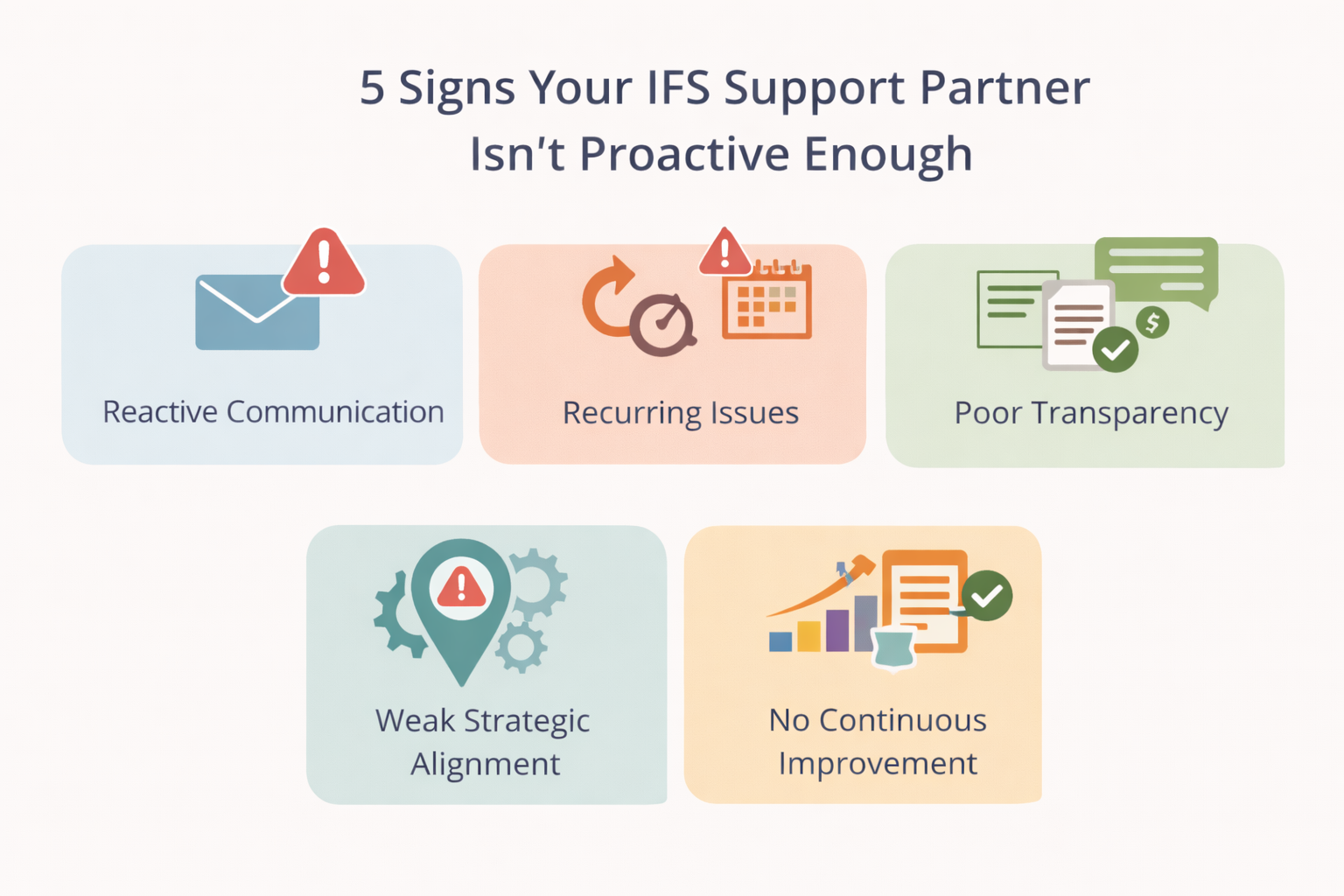
Communication problems often get dismissed as a soft issue, even though they are one of the clearest indicators of whether a provider is proactive or reactive. When a support partner communicates well, it becomes easier to manage expectations, protect business continuity, and make informed decisions about open issues, upcoming changes, and resource needs.
In an IFS environment, that matters because support activity interconnects with finance, supply chain, customer relationship management, reporting, security roles, interfaces, and upgrade planning. If communication breaks down, the effect can travel quickly across functions that depend on timely, coordinated input.
Read Next: How IFS Application Managed Services Deliver ROI, Stability, and Scale
Some incidents occur genuinely, but most recurring support problems do not. When the same crash, integration failure, posting error, print issue, scheduled job failure, or user access problem keeps coming back, the problem usually sits deeper than the visible symptom.
When the same error is logged and investigated from scratch, it often indicates poor documentation or weak root cause tracking. This appears when recurring IFS–CRM interface failures are reanalyzed each time, or when a month-end issue resurfaces and no one knows what fixed it previously. It increases effort, delays resolution, and adds unnecessary complexity.
A proactive model maintains a repeat-incident record with the root cause, workaround, permanent fix status, affected process, and responsible owner. If this record does not exist, ask for it. It quickly shows whether the provider is learning from past issues or reacting in isolation.
Workarounds are useful during outages, but become a red flag when they persist without a plan for permanent resolution. This often shows up as manual reprocessing, scheduled job restarts, spreadsheet fixes, or repeated data corrections. Over time, internal teams absorb the cost.
This usually reflects weak prioritization, limited capacity, or unclear ownership. Review recurring workarounds and ask: what caused it, what is the permanent fix, and when will it be implemented? Vague or shifting answers suggest the issue is being managed, not resolved.
Some issues take longer due to complexity, dependencies, or regulatory review. Even then, a reliable provider should clearly explain progress, blockers, and next steps. When timelines repeatedly shift without transparency, it signals weak escalation, lack of diligence, or resource constraints.
This is critical for high-impact areas like invoicing, order flow, integrations, compliance, and user access. To assess this, compare estimated vs. actual resolution timelines for recent incidents and check whether delays were documented and addressed.
An issue may be marked resolved once systems restart, even though the business impact remains. For example, integrations may run again while data accuracy is unverified, or reports may return while finance still reconciles missing outputs.
Proactive support goes beyond technical recovery. It confirms normal operations, validates outputs, checks downstream impacts, and updates documentation. If your provider stops at system recovery, it indicates a lack of business awareness needed for a true strategic partnership.
Read Next: Top Benefits of Certified IFS Partners for Your Business in 2026
Read Next: Unlocking Success: Why the Best IFS Partner Matters in 2026
Transparency issues often begin as minor frustrations, such as when an invoice arrives with vague billing descriptions or a request is marked complete, yet the business is unsure what was actually changed, tested, or validated. Over time, those problems become much more than administrative annoyances. They make it harder to manage the partnership, harder to maintain the IFS environment, and harder to determine whether your investment is producing tangible value.
That is why weak transparency is such an important red flag. Support relationships depend on trust, and trust becomes fragile when the provider’s actions are difficult to verify. In practical terms, that affects financial planning, audit readiness, upgrade preparation, incident recovery, and internal handoffs between teams.
Read Next: What is IFS ERP Software? Everything Need to Know About IFS Cloud
Read Next: A Comprehensive List of IFS ERP Modules: 2026 Guide
A support relationship can stay active while quietly losing relevance. Tickets get resolved, and meetings continue, but the partnership no longer reflects the business direction, system complexity, or risk level. This often happens when providers continue delivering the same model while the IFS environment and priorities evolve.
The clearest difference between a reactive provider and a proactive one usually appears over time. Reactive support closes tickets. Proactive support improves the environment. That distinction matters because a healthy IFS partnership should create some visible forward movement, even outside major projects.
There should be signs that the provider is learning from recurring incidents, identifying opportunities to automate routine work, improving documentation quality, refining support processes, and helping the business manage risk before it turns into disruption.
When that improvement mindset is missing, the relationship starts to plateau. Support activity may continue at a steady volume, but there is little evidence that the provider is helping the business operate more efficiently. You may notice that the same manual workarounds still exist quarter after quarter, enhancement ideas never progress beyond discussion, aging issues remain open with no clear plan, and no one brings forward insights unless the customer explicitly asks. That can indicate a lack of strategic initiative, weak account ownership, or a delivery model focused on throughput instead of long term value.
This matters most in environments where support should naturally feed improvement. If a provider regularly handles requests tied to approvals, reporting, workflows, integrations, role management, document handling, automation opportunities, or recurring transaction problems, they should be able to identify patterns and recommend practical changes.
Those recommendations do not need to become large transformation projects. In many cases, the most useful proactive value comes from smaller actions such as cleaning up recurring support documentation, tightening role design, automating a repetitive handoff, improving ticket categorization, or preparing an aging customization for a future upgrade. A provider that never raises those possibilities may lack the mindset needed for a durable strategic partnership.
Read Next: How Smart Companies Use IFS ERP to Automate Everything From Supply Chain to Finance—And You Can Too
Recognizing the pattern is important, but recognition alone does not fix the support model. Once the warning signs become clear, the next step is to turn concern into a structured review.
Support problems often begin as gut feelings, then slowly build into recurring delays, extra internal workload, and a partnership that no longer aligns with business needs. If those signals are left untested, companies tend to either tolerate poor support for too long or make a rushed decision without enough evidence.
A better approach is to document what is happening, measure the impact, and determine whether the provider can realistically improve. That gives you a practical way to protect business continuity, reset expectations, and decide what moving forward should look like.

A useful review starts with support behavior, not broad frustration. Look at the last six to twelve months of tickets, escalations, invoices, service summaries, and project-related requests. Focus on patterns in responsiveness, repeat incidents, missed updates, unclear billing, and documentation gaps, especially in areas tied to reporting, integrations, billing, month-end support, and user access. Those patterns will usually indicate whether the provider can manage your environment efficiently or whether the business is absorbing too much of the support burden.
It also helps to gather input from the teams affected by support outcomes. IT, ERP leadership, finance, reporting teams, and operations managers can often identify where issues recur, where communication breaks down, and where internal personnel are compensating for the provider’s behavior. That input matters because support problems do not always show up in the ticket system alone. They often manifest in manual workarounds, repeated follow-up, or delays that take business teams off task.
Once you have that evidence, group it into categories such as responsiveness, communication quality, root cause discipline, billing transparency, strategic input, and documentation. That structure makes it easier to identify whether you are dealing with isolated issues or a broader partnership problem.
If the review shows that the relationship can still be recovered, the next step is to define what improvement should look like in practical terms. Vague requests for better service rarely change behavior because they give the provider too much room to interpret success on their own terms. Clear expectations tied to measurable service behavior, realistic timelines, and visible accountability create a much better chance of getting the partnership back on track.
Some providers can recover after expectations are reset. Others continue the same behavior under new promises. That is why the decision to move on should be based on pattern, response to feedback, and long-term fit, rather than on one difficult incident. Staying with the wrong provider carries its own cost through repeated delay, weak transparency, higher internal workload, and slower progress on upgrades or improvements.
This decision usually becomes clearer after the provider has had a fair chance to respond. If they accepted concerns seriously, improved communication, demonstrated better discipline, and addressed the underlying issues within a realistic timeline, the partnership may still be viable. If they stayed defensive, provided little evidence of change, or kept repeating the same support behavior, the relationship may no longer be sustainable.
Before moving forward, review the contract, open issues, documentation quality, integrations, customizations, and handoff risk. Then define what the next provider must do better, whether that is stronger responsiveness, clearer billing, better documentation, more strategic input, or a more collaborative service model. That level of diligence helps ensure a smooth transition and keeps the business from trading one support problem for another.
Read Next: Top 10 Questions to Ask Potential IFS Partners: 2026 Selection Guide
Once the immediate warning signs are under control, the bigger question is whether the provider can support the business as the IFS environment grows more complex. That may involve aging customizations, more integrations, changing regulatory pressure, or higher expectations around reporting and automation. If the partnership cannot adapt to those shifts, support can feel stable in the short term while still becoming a long-term constraint.
That is why sustainable IFS support should be evaluated through a wider lens. A provider should be able to maintain day-to-day service quality while also helping the business stay organized, visible, and ready for change.
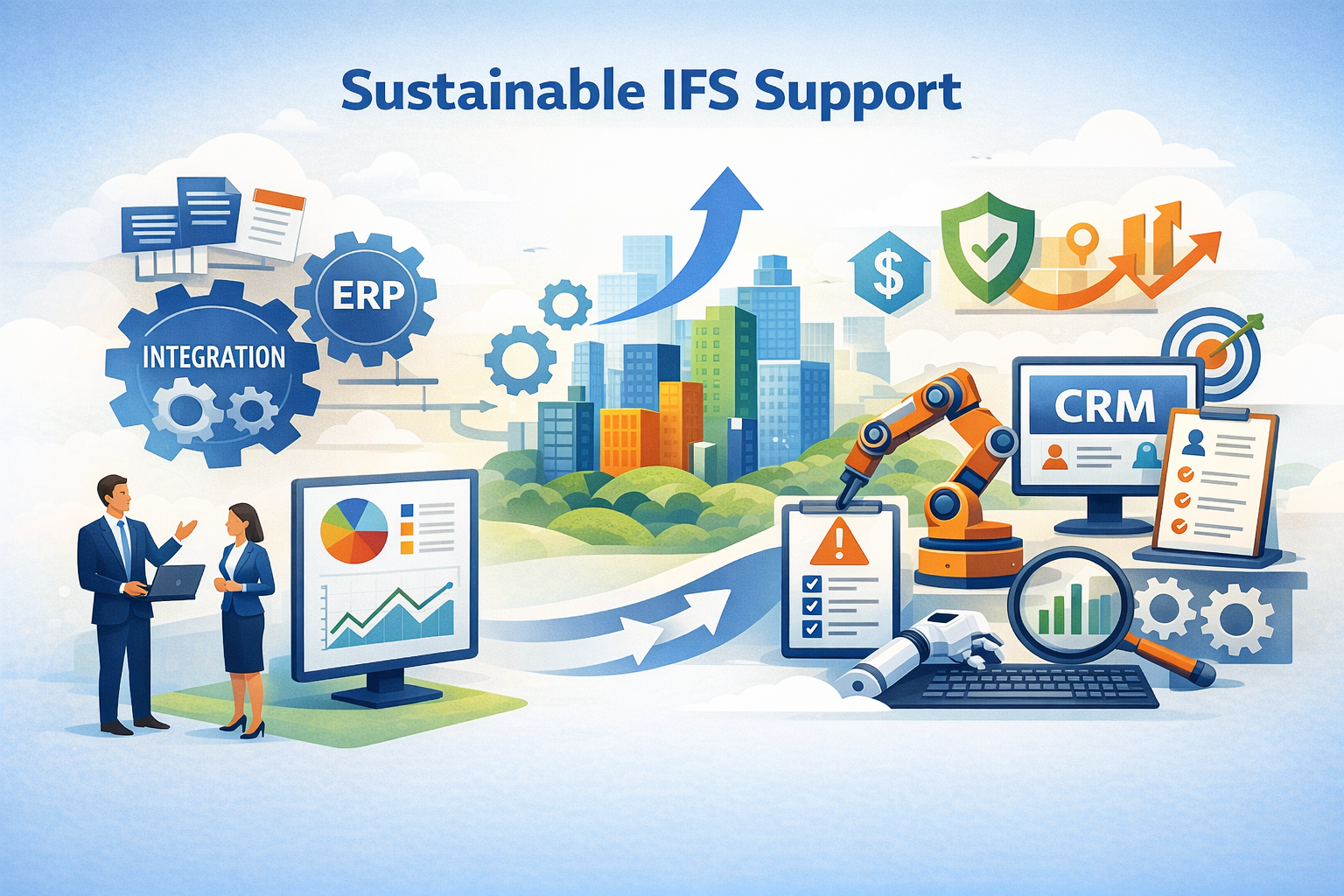
A strong support model depends on shared context, open communication, and clear ownership on both sides. Without that, the provider is forced to react to isolated requests, and the customer is left translating technical activity into business impact. Over time, that weakens the partnership and makes support less useful as an operational tool.
A more strategic relationship usually shows up in how well the provider understands business priorities, critical processes, and the parts of the IFS environment where disruption creates the most pressure. That context helps them tailor recommendations, identify risks earlier, and support decisions with more precision. It also makes service reviews more valuable because the conversation reflects actual business needs instead of generic support updates.
Collaboration also needs structure. If updates are infrequent, concerns only surface during escalations, or ownership feels unclear, the relationship will struggle to mature. Better results usually come from mutually agreed communication rhythms, clear escalation paths, and open communication about upcoming changes, operational pain points, and improvement priorities.
Proactive support becomes easier to sustain when the provider uses automation and connected systems to reduce manual effort and identify patterns earlier. Without that discipline, support teams often spend too much time reacting to recurring issues that could have been categorized, escalated, or analyzed more efficiently.
Read Next: IFS ERP for Smart Manufacturing: Integrating IoT, AI & Industry 4.0
Outgrowing an IFS support partner usually happens long before anyone says it out loud. The signal shows up in recurring delays, weak transparency, generic advice, unresolved root causes, and internal teams spending too much time managing around support gaps. Once those patterns start to recur, the issue is no longer about isolated service frustration. It becomes a question of whether the partnership still supports business continuity, operational efficiency, and the long-term value of your IFS investment.
IFS support decisions affect visibility, stability, and how confidently the business can plan its next upgrade, integration change, or process improvement. Astra Canyon Group provides better-aligned support with ongoing operational demands. Get an IFS support review to pinpoint where your current provider may be creating recurring friction, weak accountability, or unnecessary internal workload so you can make a clearer decision about the right path forward.
 Blake Snider : Apr 29, 2026, 11:00:00 AM
Evaluate IFS Cloud for enterprise asset management EAM across asset data, planning, compliance, analytics, and support before rollout.

 Bri Dascher : Feb 11, 2026, 10:13:54 AM
Learn how Caregility migrated from IFS 7.5 and Vision Extension to IFS Cloud, achieving data separation and operational independence with Astra...
 Bri Dascher : May 5, 2025, 3:57:40 PM
Learn how Caregility migrated from IFS 7.5 and Vision Extension to IFS Cloud, achieving data separation and operational independence with Astra...